The Recurring Problem of Negative Midday Prices
- February 10, 2026
- 0

by Carlos Korten, Green Tiger Markets
February 2, 2026
Not Just Good Friday Anymore

Green Tiger Markets has been monitoring the escalating risk of negative midday prices in the wholesale electricity market, with concern, for over a year.
We first observed and described the phenomenon of recurring negative wholesale prices as a peculiarity associated with Good Friday, a day which exhibits very low nationwide demand for electricity. Midday electricity prices have reliably fallen below zero on Good Friday over the last few years, and is expected to do so again in 2026.
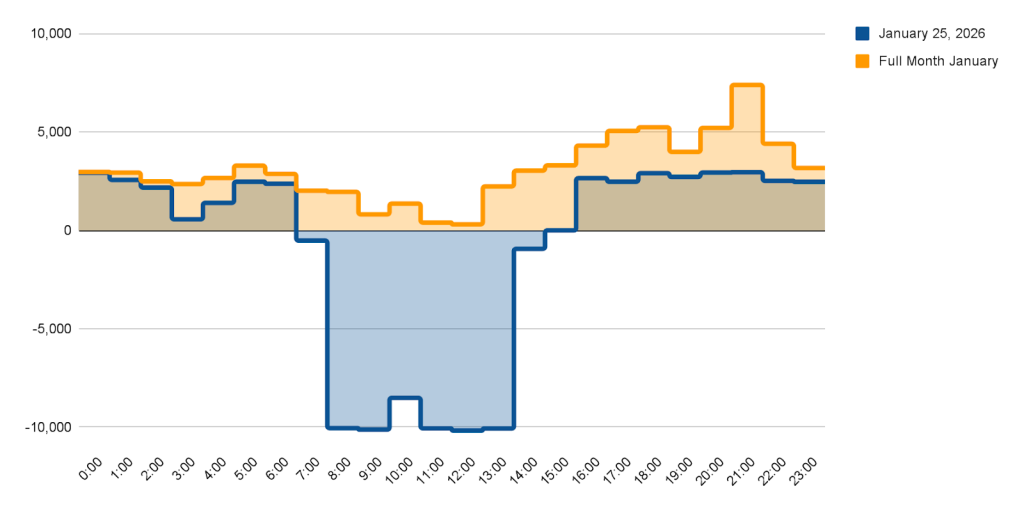
As we enter 2026, the market trend which causes negative prices on Good Fridays is now becoming more prevalent and pronounced. On January 25, 2026, midday power prices fell massively negative for an eight hour period from 7AM until 2PM, reaching a low price of negative 10.167 php / kwh. On February 1, 2026, just one week later, midday prices dropped to negative-10 again, during the 9am hour.
What makes these new incidents peculiar and troubling is the fact that these days were not national holidays; nor did the country experience a typhoon signal or natural disaster which might disrupt market demand. Instead, for the first time, negative power prices were observed on consecutive Sundays in the normal course of events, on non-working days characterized by mild and sunny weather.
In short, this is no longer a once-per-year anomaly reserved for Good Friday. It has become regular and endemic.
Chart: Luzon Wholesale Power Prices, by hour (php/MW), January 25, 2026 vs. Full Month January 2026
Why are Negative Prices a Bad Thing?
Some readers may wonder why we should be concerned about deeply negative electricity prices. Surely this market signal proves there is abundant power supply and falling prices, which are both desirable things. Unfortunately, the implications are more ominous.
These price shocks indicate that the physical infrastructure of the national grid is under stress. On mild and sunny Sundays, during midday, power generators are now dispatching significantly more energy than can be consumed, and the grid is becoming dangerously overloaded.
This state of oversupply is an early warning that the grid is at mounting risk of a catastrophic failure. It may “blow a fuse”– a concern made more concrete and specific following the systemic power failure on the Iberian peninsula in April 2025, which plunged Spain and Portugal into darkness. Similar problems with grid dynamics are at play here in the Philippines.
In showing deeply negative prices, the grid is exercising its available contingencies. First, the grid forces generators who are unable to curtail their power generation to pay a massive premium– over 10 pesos per kilowatthour– for the privilege of dispatching their unwanted power. Second, the grid offers a massive cash bounty to energy distributors encouraging them, with escalating urgency, to draw more power from the grid in an effort to equalize demand against oversupply.
Coal plus Solar creates a Fragile Cocktail
Coal and solar technologies are the major actors in this story. Coal-fired plants are limited in their ability to modulate their generation from hour to hour. Solar power, on the other hand, is variable by nature, providing a massive shock of midday power with priority dispatch, but none before sunrise, and none again after sunset. The nation’s extensive coal-fired infrastructure– more than 50% of all power generated– cannot modulate quickly enough to efficiently “stand down” during sunrise, or “fill in” again at sunset.
Taken together, expanding solar overlaid upon an inelastic coal backbone produces a fragile supply-side cocktail that forces the grid to dangerous limits. As more solar power generation is added in the coming years, this situation will become more dire.
Where are the Shock Absorbers?
The emerging Reserve Power market, in which power generators are paid to be on stand-by, is designed to address situations when the grid needs a spike of additional power on short notice. Unfortunately the design for a rapid response in the inverse– to efficiently handle situations where baseload power generation must be quickly curtailed– has not been adequately addressed.
Power markets in Europe and North America benefit from extensive generation capacity from natural gas plants, which can modulate power generation quickly, providing important shock absorbers for those grids. While the Philippines has some natural gas facilities, as well as impounded hydro resources which can spool or curtail power on short notice, the installed capacity of those technologies represents less than 30% of the country’s supply, and their beneficial effects are quickly exhausted.
In recent years, policy makers have signaled interest in promoting nuclear and offshore wind technologies for investment. Unfortunately, neither of these technologies is likely to address the problem of supply-side inelasticity– and they may make the situation worse. Without massive new investment into baseload power technologies that offer elasticity of supply– such as natural gas, batteries and impounded hydro– the country will be walking a precarious road in delivering on its promise of affordable and reliable power.
About Carlos Korten

Green Tiger Markets president Carlos Korten has been designing and deploying technology innovation solutions for over 25 years, including leadership roles at Andersen Consulting and American Express. A product strategist, veteran leader, software developer and artist, he draws on diverse skills to drive business growth. Carlos studied at the University of Chicago, London School of Economics and Harvard University.