MTerra Solar as a turning point: What the Philippines can learn from MGEN’s integrated solar-battery model
- December 26, 2025
- 0
For much of the Philippines’ energy transition, solar power has been viewed as inherently limited — valuable, but variable, and unable to compete with fossil fuels beyond daylight hours. Meralco PowerGen (MGEN)’s MTerra Solar project is beginning to change that narrative.
Speaking on Power Podcast, MGEN President and CEO Manny Rubio described MTerra Solar, which spans 3,500 hectares across Nueva Ecija and Bulacan, as “trailblazing,” not simply because of its size, but because of what it proves about the role of renewables in the power system. “This project, MTerra Solar, has finally proven that a combination of variable renewable energy integrated with an energy storage is competitive [with] traditional sources of mid-merit supply,” Rubio said.
MTerra Solar is targeting 3,500 MWp of solar and 4,500 MWh of battery capacity by 2027, enough to supply 2.4 million homes and cut millions of tons of carbon emissions each year.

The project integrates large-scale solar generation with a battery energy storage system, enabling it to deliver firm, dispatchable power well after sunset. “We’ll be providing 850 megawatts from 8AM to 9PM,” Rubio explained. “So even when the sun is down, we’ll be providing 850 megawatts up to 9PM–that block. So that’s something that’s trailblazing.”
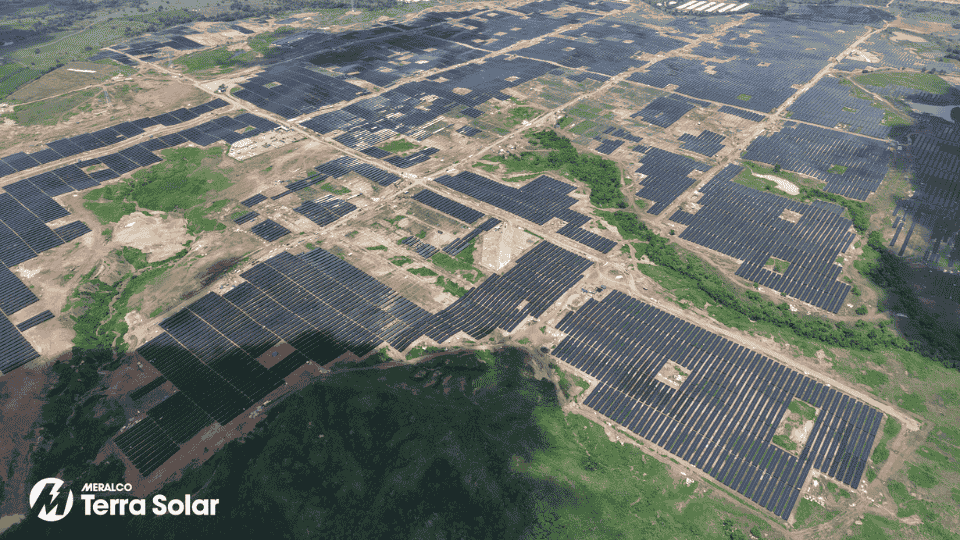
MTerra Solar Becomes Largest Solar PV Installation in PH /MGEN
This design places MTerra Solar squarely in the mid-merit segment — a role historically filled by diesel plants and, more recently, gas engines. According to Rubio, this is where the project becomes transformative for the Philippine grid. “At least now, we can consider variable renewable energy and energy storage, in this case a battery, to provide mid-merit,” he said, calling it a critical step forward for the energy transition.
Beyond the single project, MTerra Solar offers a template for what could come next. “We’re even now looking at replicating that, albeit on a smaller scale, maybe anywhere between 300 to 400 megawatts, constrained of course by land availability,” Rubio said.
The MTerra Solar project suggests that storage-backed renewables are no longer confined to supporting roles, but can directly compete with fossil-based plants on reliability and cost — a development that could accelerate the shift away from mid-merit diesel and gas sooner than many had expected.
Rubio was clear, however, that this is part of a broader, carefully managed transition. “Each technology has a role to play,” he said, emphasizing that grid stability, system costs, and practicality must remain central to planning decisions. Still, MTerra Solar marks what he described as an early “tipping point” — proof that integrated solar and storage can now shoulder responsibilities once thought exclusive to thermal power.
The full discussion on MTerra Solar, grid stability, and the future of integrated renewables is explored in depth in this episode of Power Podcast featuring MGEN President and CEO Manny Rubio. Watch or listen to the episode here.
Can integrated solar and battery projects realistically take over the mid-merit role in the Philippines’ power system — and what needs to change for this to scale?
Follow Power Philippines on Facebook and LinkedIn or join our Viber community to stay up to date on the latest energy news.