More solar isn’t enough: Why the Philippines needs forward electricity markets
- January 1, 2026
- 0

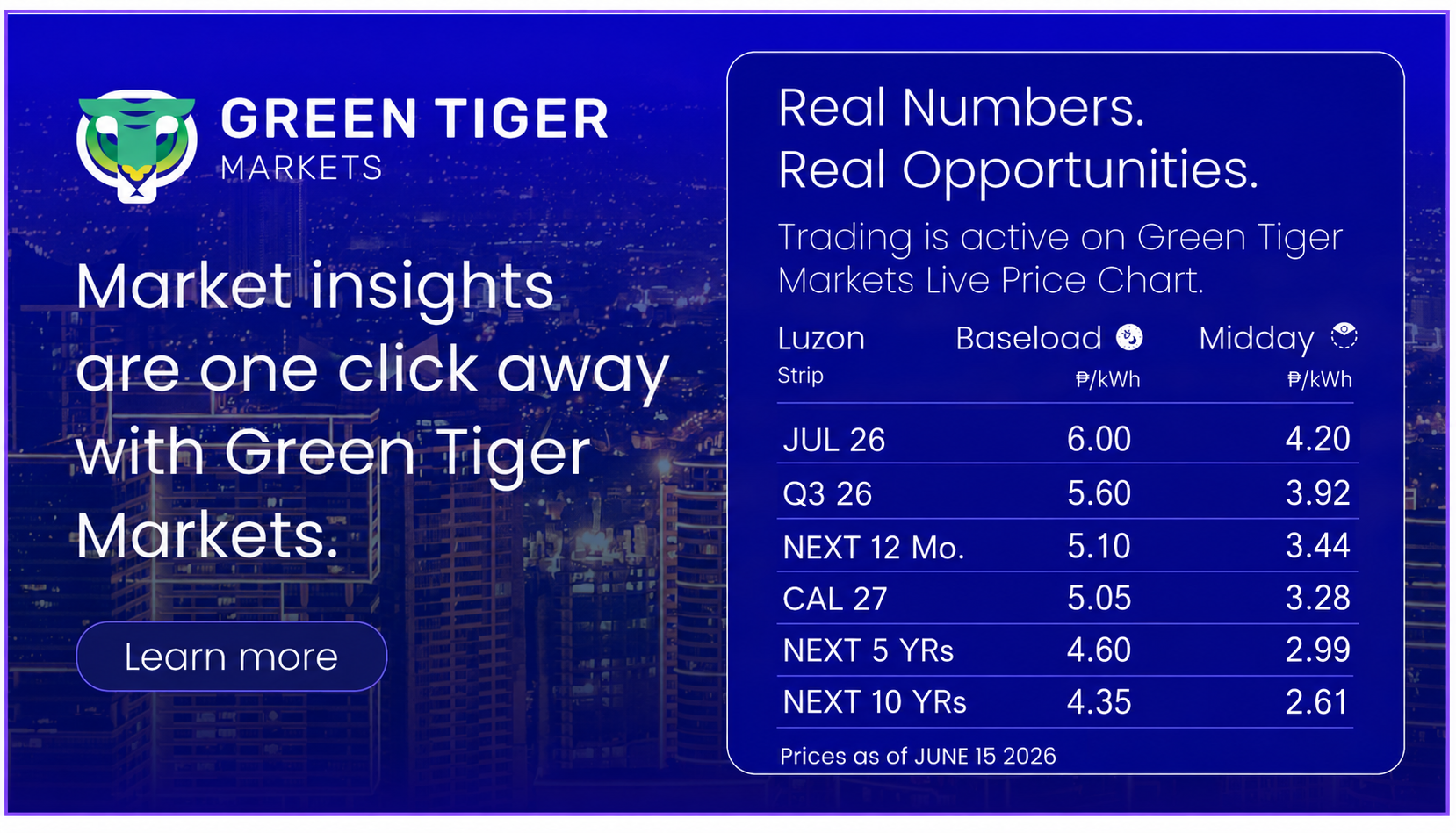
The Philippines’ push toward 50% renewable energy (RE) by 2040 is often framed as a race to build more solar and wind farms. But according to Green Tiger Markets (GTM) CEO and founder John Knorring, generation alone will not get the country there. Without a way to manage price risk in an increasingly volatile power market, many renewable projects may never reach financial close.
In his Power Podcast interview, Knorring said that the next phase of the energy transition will be decided less by megawatts installed and more by whether developers can survive collapsing spot prices—particularly during solar-heavy midday hours.
“We don’t build generation,” Knorring said. “We make it possible for firms to manage risk—and that’s what unlocks RE investment.”

As solar capacity accelerates, the Philippine power market is showing early signs of stress. Midday prices are weakening as supply outpaces demand, a trend Knorring says will intensify rather than correct itself. By the latter half of the decade, developers selling into the spot market may face sustained periods where prices are not just low, but negative.
In that environment, traditional contracting tools are increasingly misaligned with market realities. Long-term power supply agreements (PSAs) remain the backbone of project finance, but Knorring noted that they are slow, rigid, and difficult to scale. Negotiating a single PSA can take months—or years—making them impractical for a fast-evolving market.
Meanwhile, government programs such as the Green Energy Auction Program (GEAP) have helped kick-start renewable development, but cannot absorb all future capacity. Not every project will secure an auction slot, and not every investor can rely on sovereign-backed contracts.
“For firms that aren’t able to access the GEAP,” Knorring explained, the alternatives narrow quickly: “Find a counterparty, do a long-term PSA—it takes a really long time—or come on GTM and, in a couple of clicks, be able to manage literally billions of pesos of market exposure to the price of electricity.”
The core challenge is cash flow stability. Renewable developers may have low operating costs, but they are highly exposed to price volatility once generation begins. If midday prices collapse—as seen in other solar-heavy markets—revenues can fall below levels needed to service debt or meet return thresholds.
This is where forward markets enter the picture. Through standardized contracts for difference (CFDs), GTM allows developers, utilities, and retail electricity suppliers to lock in future prices without changing physical dispatch. The contracts settle financially against WESM prices, separating operational performance from market volatility.
Knorring likened the mechanism to practices long used in mature energy markets. “What the forward market is,” he said, “is instead of hedging the electricity risk on an instantaneous basis, you can do it for a week, a month, a year, 10 years, all at the same time.” That price certainty, he added, is what enables long-term planning and investment.
Crucially, forward markets also address a misconception about renewables and pricing. Falling prices are not inherently bad—but unmanaged risk is. “Lower prices aren’t necessarily bad for generators if they are able to manage their price exposure,” Knorring said. Without hedging, however, even efficient renewable assets can become financially distressed.
The implications extend beyond developers. If renewable projects struggle to secure financing, the pace of capacity additions slows—putting national targets at risk. In Knorring’s view, a liquid forward market is not a financial add-on, but a core piece of transition infrastructure.
As the Philippines moves deeper into market-based pricing and higher renewable penetration, the question becomes whether risk management tools can scale as fast as generation itself. Solar farms may deliver electrons—but without mechanisms to stabilize revenues, capital may stay on the sidelines.
This theme is explored in depth in the Power Podcast episode featuring Green Tiger Markets CEO John Knorring. Listen to the full conversation here.
If price volatility continues to rise as renewables scale up, should forward markets be treated as essential energy infrastructure—and are policymakers and developers giving them enough attention today?
Follow Power Philippines on Facebook and LinkedIn or join our Viber community for more updates.