OpenSolar 3.0 levels the solar rooftop playing field–for free
- January 21, 2026
- 0
While the Department of Energy targets 35% renewable energy by 2030 and the country’s largest conglomerates race to build utility-scale solar farms, a quieter but potentially more transformative shift is happening at the household and SME level: a global software company has just handed every small solar installer in the Philippines the same professional tools used in Australia, the United States, the United Kingdom, and beyond—for free.
OpenSolar, the Australian-born platform with a workforce comprising 30% Filipino talent, officially launched its most powerful version yet — OpenSolar 3.0 — featuring a new AI Auto Design assistant,Ada. The upgrade is being described by the platform’s thousands of users as “game-changing” and by the company itself as the catalyst that will finally “democratize” distributed solar across the archipelago.
“We do not believe the energy transition in the Philippines will be won by one or two giant players installing solar for the entire country,” David Ramirez, OpenSolar’s Director of Customer Experience for New Markets, told Power Philippines in an exclusive interview. “We believe it will be won by hundreds, and eventually thousands, of small, local companies serving millions of Filipino households and businesses. Our job is to give them the tools.”

Since formally entering the Philippine market at the beginning of 2025, OpenSolar has signed up more than 300 local solar firms—from single-proprietor engineers and retired OFWs to established installers deploying hundreds of systems a month.
In 2025, the platform facilitated over 10,000 solar proposals for Filipino homes and businesses. With many of these quotes moving to installation, OpenSolar is actively accelerating the nation’s shift to solar energy.
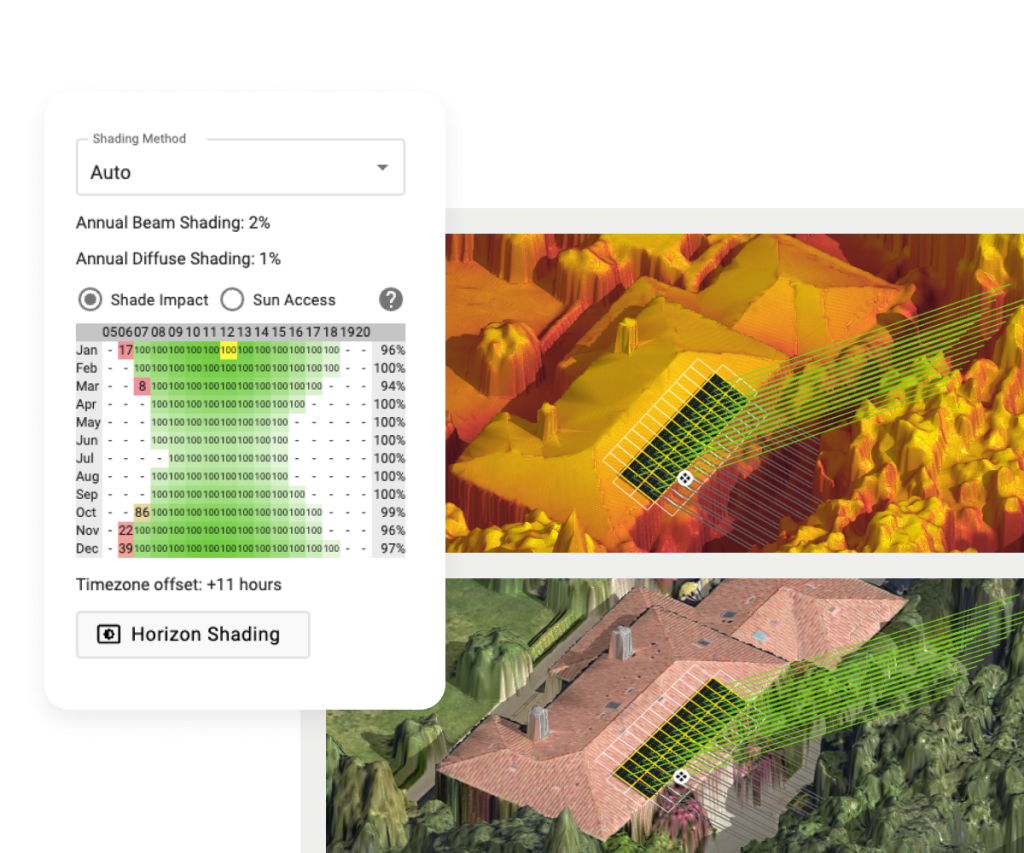
OpenSolar’s 3D modelling allows for accurate solar generation and shading analysis
The workflow is disarmingly simple yet highly accurate and effective:
1. Enter a customer’s address → high-resolution Google satellite imagery loads instantly (OpenSolar enjoys preferential access thanks to a direct investment from Google).
2. Input the monthly electric bill or kWh consumption → Meralco, Visayan Electric, or the relevant distribution utility rates auto-populate.
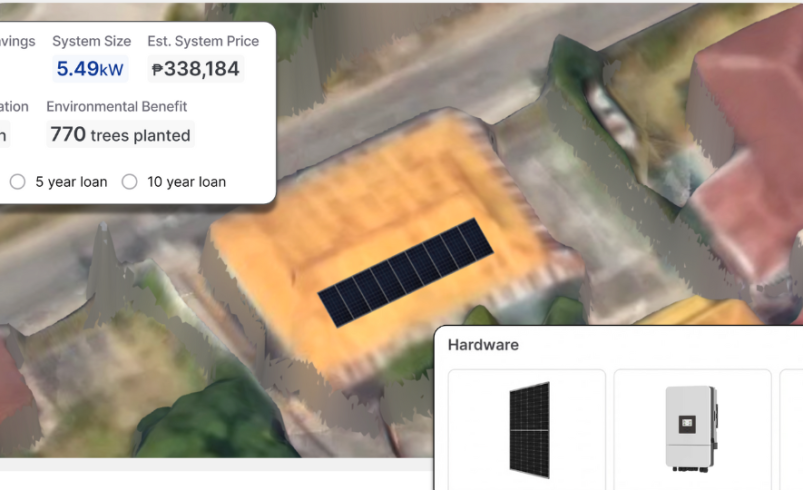
3. Click “Ada” (Auto-Design Assistant) → the AI instantly places the optimal number of panels, selects inverters and racking, calculates tree-by-tree and building-by-building shading, and prices the entire system using real-time component data.
4. Generate a fully branded, interactive 3D proposal that the homeowner can open on any device.
5. Streamline operations from sale to install by managing the entire project lifecycle with stage management, action scheduling, team assignments, and one-click document generation.
“Less than five minutes from a blank page to an accurate design and engaging sales proposal — and it’s completely free,” Ramirez demonstrated during the interview. “That is the entire end-to-end process.”
While some users are scaling their sales and operations 5x, the true differentiator is quality. OpenSolar democratizes access to high-end design tech, meaning even the smallest teams can now compete with major EPCs on professionalism and win rates.”
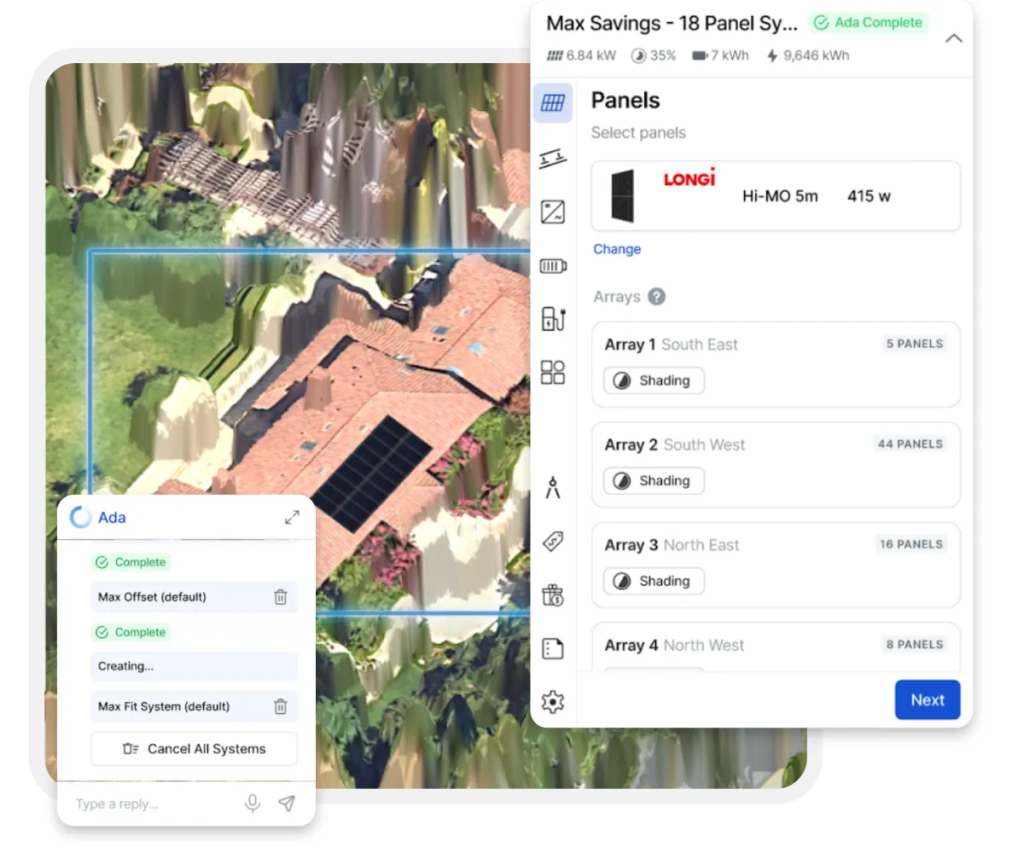
OpenSolar’s AI Tool, Ada, helps speed up the design-to-sales workflow
OpenSolar’s energy-yield engine is one of the few commercial platforms formally validated by the U.S. National Laboratory of the Rockies (NLR) , showing minimal discrepancy against real-world production data. The new AI layer combines Google’s highest-resolution imagery, local weather files, granular shading analysis, and continuously updated pricing databases.
“Two weeks after we launched Ada globally in September 2025, 10% of every design created worldwide was 100% AI-generated,” Ramirez revealed. “That pace has only accelerated.”
OpenSolar’s promise to keep its software free of charge is the core of a business model built to expand solar adoption from the ground up. Instead of charging installers, the platform is funded by the ecosystem surrounding them.
Manufacturers and distributors pay to be visible where it matters most: inside the proposal and design workflow used by more than 28,000 professionals worldwide. In mature markets, this includes an integrated marketplace—essentially the Lazada or Shopee of solar hardware — where installers can compare components, place orders, and track deliveries. A Philippine rollout is planned for 2026.
Financing partners also integrate with the platform, paying small referral fees in exchange for access to installers and end-users looking for loan options. Meanwhile, more than 180 brands globally support product training, webinars, and enhanced placement within OpenSolar’s component library.
All of these services create a virtuous cycle: partners gain exposure and sales, installers get a powerful zero-cost software suite, and OpenSolar maintains a free, unrestricted platform designed to democratize the solar business — especially for SMEs and first-time entrepreneurs.
OpenSolar’s vision is explicit: an archipelago dotted with small, tech-enabled solar businesses capable of serving their immediate communities faster and more accurately than any centralized corporation.
“We call our users ‘Pros’ — short for solar professionals,” Ramirez said. “Imagine a Pro in every municipality who can quote, design, finance, and install a system faster than anyone else. That is the distributed army that will actually deliver the country’s renewable energy targets.”
With OpenSolar 3.0 now live, weekly free training webinars conducted in Philippine time zones, and the forthcoming distributor marketplace, the infrastructure for that army is finally in place.
As one installer told Ramirez after generating his first AI proposal:
“I used to spend four hours per quote. Now it takes four minutes — and our clients say that it looks better than anything the big companies send.”
In a market that added more than 1GW of rooftop and C&I solar in the past two years and is projected to add several gigawatts more by 2030, the quiet arrival of professional-grade, zero-cost software may prove to be the single most powerful accelerant of the Philippine rooftop revolution.
Try the platform for free. Create an OpenSolar account —no credit card required.
Do you think democratized, software-driven solar tools like OpenSolar can meaningfully speed up the Philippines’ clean energy transition? Share your thoughts.
Follow Power Philippines on Facebook and LinkedIn or join our Viber community for more updates.