Monopiles, jackets, and floating foundations? JBO urges tailored foundation designs for Philippine offshore wind
- April 7, 2026
- 0
Offshore wind in the Philippines faces hurdles ranging from limited port infrastructure to typhoon-prone waters. Germany-based JBO Engineering Group said foundation designs must be tailored to meet these local conditions.
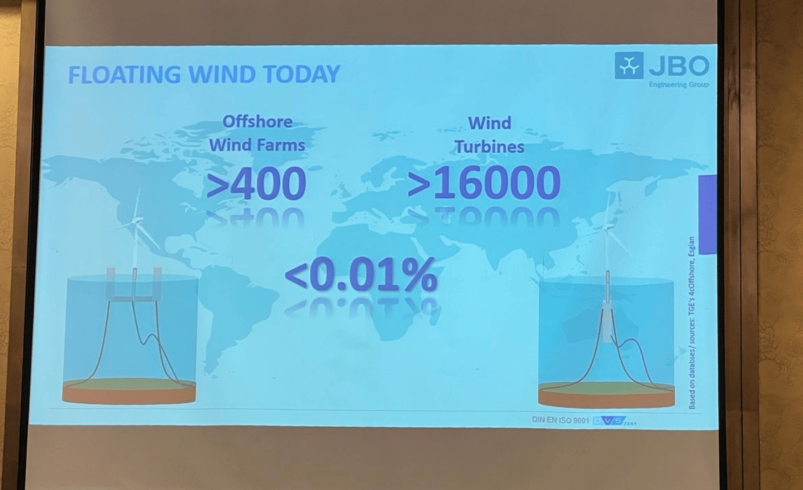
JBO Engineering Group Managing Director and Director Offshore Walid Al Otaibi presented on offshore wind foundation design and challenges specific to the Philippine market, as he served as a speaker during the 4th Philippines Onshore Offshore Wind Summit (POOWS) 2026 at Dusit Thani Manila.
According to Walid, the Philippines faces unique challenges in offshore wind development, including ports that are not fully equipped for offshore wind logistics, as well as limited installation vessel capacity and infrastructure constraints requiring oversized components.
“I think, geographically, we all know where the Philippines is located, so getting those foundations or getting those turbines to the Philippines will be a challenge, which might, in some cases, even limit the supply chain that is available for the Philippine market,” he said.
Other challenges include high CAPEX cost for difficult site conditions, long lead time, and environmental loads, such as typhoons, earthquakes, and strong winds, which require advanced engineering to optimize the foundation and minimize steel use.
For foundation design, Walid recommended adapting solutions to local conditions and constraints.
For bottom-fixed structures, he said monopiles offer faster, semi-automated fabrication and lower cost but are limited to shallower depths.
“The choice of the foundation can sometimes depend on what vessels are available in the country. I don’t need to design a monopile foundation that’s 3000 tons, which is too heavy, if the vessels that are locally available can only lift something, let’s say 1500 tons,” Walid said.
“That might be a reason that I move to jacket structures instead of monopile structures,” he added.
Jacket foundations, on the other hand, allow deeper installation but require more manual labor, higher CAPEX/OPEX, and longer lead times.
“When we go to water depth, with the monopile foundation, we can go up to 60 meters at the moment, which is still already on the limit. With jackets, we can reach up to 75 meters, and again, those will be heavy structures, also on the limit,” Walid explained.
For local fabrication in the Philippines, Walid believed that the most practical approach at present is to produce secondary steel locally, while sourcing large structures from abroad.
“The fabrication capacities in APAC are available whether it’s in Taiwan, Vietnam, China—they’re available and can be sourced,” he said.
Walid said there are over 300 floater concepts, each claiming to be the best, but the German engineering consultancy suggested focusing on more cost-effective designs similar to monopiles—using large tubular components that can be mass-produced.
“You can see such a floater design that we see on the market in Europe. It comes from different component parts, all tubular-shaped or conical-shaped, that can be built by any monopile fabricator facilities; they can be shipped here, the final assembly can be done here, and then they’re ready to be installed offshore,” he shared.
He continued, “Basically, this is how it would look like. You get the tubes, you do the assembly, the installation of the turbine, etcetera, and they’re ready to go offshore.”
Walid’s presentation highlighted that efficient offshore wind development in the Philippines requires smart foundation design choices, early planning, and a balanced integration of global and local resources.
Follow Power Philippines on Facebook and LinkedIn or join our Viber community for more updates.