OMF tops 3M trees as mangrove, watershed drives expand nationwide
- April 23, 2026
- 0
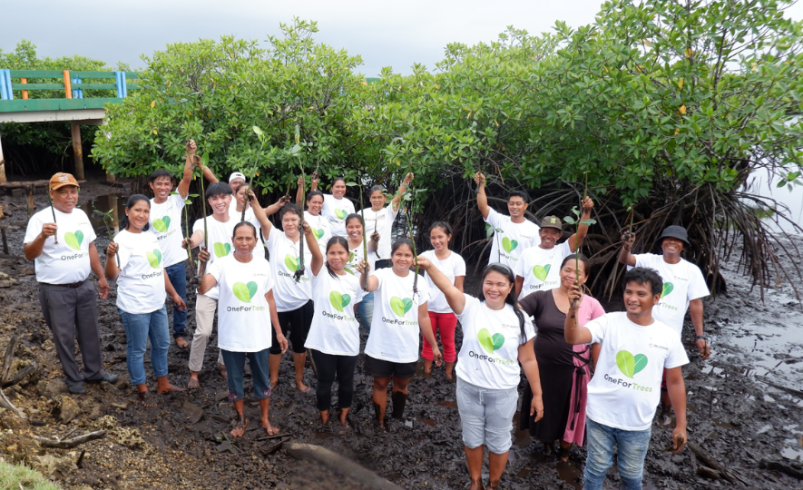
The One Meralco Foundation (OMF) has surpassed 3 million trees planted under its One For Trees (OFT) program, scaling up a nationwide reforestation effort that now spans mangroves, watersheds, and upland forests while directly engaging thousands of community stewards across the Philippines.
Since its launch in 2019, OFT has planted and nurtured 3,045,104 trees across 36 reforestation sites, with 165,141 additional trees planted in 2025 alone and a reported 92% survival rate. The program also supports 2,492 tree farmers who serve as frontline custodians of the reforested areas.
OMF celebrates the milestone in line with Earth Day 2026, themed “Our Power, Our Planet,” highlighting how local communities have become central actors in long-term ecosystem restoration.

Mangroves as livelihood and coastal defense
In Ibajay, Aklan, community member Retchie Sacapaño represents how coastal protection efforts are increasingly tied to livelihoods and local stewardship.
Once familiar with mangroves only as a childhood backdrop, she later became a tour guide and conservation advocate in the Katunggan It Ibajay Mangrove Eco-tourism Park under the Bugtongbato Fisherfolk Association (BFA).
“I found out how essential the mangrove forests are to us,” Retchie shared. “We don’t just earn money; we also became tour guides and educate our visitors on why we must preserve our forests.”
Through OFT, her community planted 50,000 mangroves in 2023, with volunteers conducting weekly monitoring to ensure survival and growth in previously degraded areas.
OMF said these interventions are designed not only for ecological recovery but also intergenerational benefit, with community members explicitly framing the work as long-term inheritance for future generations.
Watershed restoration tied to water security
In Butuan City, Agusan del Norte, reforestation efforts in the Taguibo Watershed highlight the link between forest recovery and potable water security for downstream populations.
Senior citizen Danilo Dandanon Sr., a member of the Manobo community, has planted 600 seedlings, including fruit-bearing species such as durian and lanzones, under OFT’s partnership with the Butuan City Water District (BCWD). Across the site, 48,000 trees have been planted and nurtured by local organizations including the Anticala Watershed Farmers Producer Cooperative and indigenous community leaders.
The initiative integrates agroforestry, allowing farmers to generate income while supporting long-term forest regeneration—positioning reforestation as both an environmental and livelihood intervention for ancestral domains supplying water to more than 250,000 people.
Coastal resilience after extreme weather events
In Del Carmen, Surigao del Norte, OFT’s mangrove restoration efforts are being positioned as part of climate resilience infrastructure following the impact of Super Typhoon Odette (Rai) in 2021.
Residents reported that mangrove belts helped reduce storm impact across coastal communities, reinforcing their role as natural protective buffers.
Through partnerships with the local government and the Kaanib ng mga Mangingisda at Magsasaka ng Numancia (KAMAMANA), OFT has supported the planting of 125,000 mangroves across 50 hectares, alongside livelihood shifts toward eco-guiding and conservation work.
The area’s ecological recovery gained further recognition in November 2024, when the Del Carmen Mangrove Reserve was designated as the Philippines’ 10th Ramsar Site, a Wetland of International Importance, covering nearly 4,900 hectares and representing more than half of Siargao’s mangrove forest.
Sierra Madre restoration and volunteer participation
In Luzon, OFT’s upland efforts focus on strengthening the Sierra Madre range, widely regarded as a natural barrier against tropical cyclones.
At the UP Laguna-Quezon Land Grant in Siniloan, Laguna, the program has planted 285,739 trees, with volunteers—including Meralco employees—participating in reforestation activities alongside technical partners such as Fostering Education & Environment for Development, Inc. (FEED).
“Our nature serves as protection against calamities,” said employee volunteer Raizza David. “And I want to contribute to making our mountains stronger.”
Long-term ecosystem strategy
Across sites, OFT emphasizes native and endemic species to support biodiversity, water retention, and coastal protection, while aligning livelihood models with conservation outcomes.
Back in Aklan, Retchie and other community members continue weekend monitoring and replanting activities within mangrove sites, reinforcing the program’s maintenance-driven approach rather than one-time planting interventions.
“Long after we’re gone, the benefits of what we’re doing will still be here for our children and their children,” she said.
With more than three million trees now established, OFT is positioning itself as a long-term ecosystem restoration platform that integrates climate resilience, livelihood development, and watershed protection across multiple Philippine landscapes.
The scale of implementation raises broader questions for energy, infrastructure, and climate resilience stakeholders on how nature-based solutions can be embedded into national sustainability and risk reduction strategies.
What does the growing scale of corporate-led reforestation mean for the Philippines’ long-term energy and climate resilience agenda?
Follow Power Philippines on Facebook and LinkedIn or join our Viber community for more updates.