Industry leaders see Philippines emerging as regional renewable energy hub
- June 19, 2026
- 0
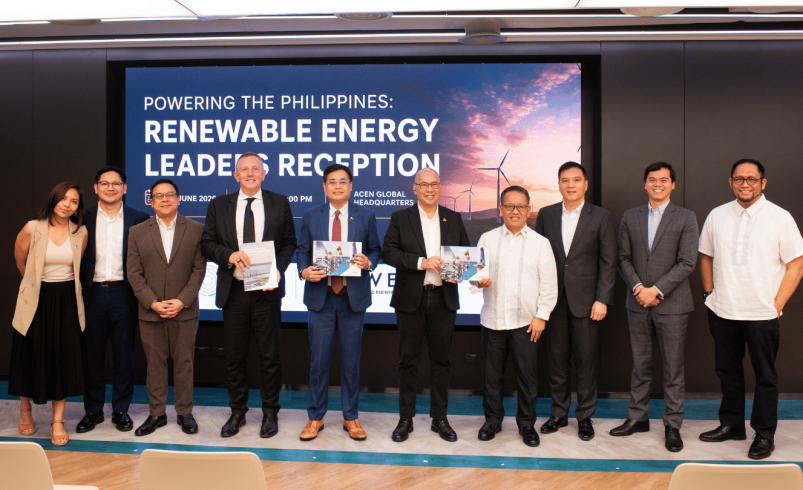
Government officials, renewable energy developers, and international organizations gathered at ACEN’s Makati headquarters for the Powering the Philippines: Renewable Energy Leaders event, where speakers expressed confidence in the country’s potential to become a renewable energy hub in Southeast Asia.
The event, held on June 16, was organized by the Global Wind Energy Council (GWEC), the Global Renewables Alliance (GRA), and ACEN. It brought together representatives from the wind, solar, and energy storage sectors to discuss renewable energy deployment, offshore wind development, electrification, investment, and policy coordination.
Miguel De Jesus, Managing Director and COO of ACEN, said the Philippines is well positioned to play a stronger regional role in clean energy, citing the country’s renewable energy resources and continued growth in electricity demand.

“We’d like to think that the Philippines is very well positioned to become a regional clean energy leader, given our rich renewable energy resource and strong, consistent growth in energy demand,” De Jesus said. However, he said this opportunity would depend on continued progress in transmission, permitting, market design, and investment frameworks.
Ben Backwell, CEO of GWEC and Chairperson of GRA, said the Philippines has already created one of the clearest renewable energy frameworks globally, while also commending the government’s collaboration across agencies.
“The Philippines doesn’t need to wait for the energy transition. It’s already leading it in many areas,” Backwell said.
He added that the country has the people, knowledge, capital, and resources needed to strengthen its clean energy position, while emphasizing the importance of grid readiness and practical investments in ports and other infrastructure.
The event also served as the Philippine launch of GWEC’s Global Offshore Wind Report 2026 and GRA’s Electrification Campaign.
Ann Margaret Francisco, Asia Pacific Director of GWEC, said offshore wind remains one of the fastest-growing energy industries globally, with 9.2 gigawatts added in 2025, bringing total global installed offshore wind capacity to 92.5 GW.
She said GWEC expects 328 GW of new offshore wind capacity to be added over the next decade, with nearly 60% of future installations expected in Asia.
“The question is no longer whether offshore wind will happen in Asia. It will happen. The question is which country will capture jobs, investments, port, manufacturing, and energy security benefits that come with it,” Francisco said.
For the Philippines, she noted that the World Bank has mapped around 178 GW of offshore wind potential, adding that even realizing a portion of that potential could have major implications for energy security, investments, and job creation.
Rexor Amancio of GRA also introduced the organization’s Electrification Campaign, which seeks to accelerate the shift of transport, buildings, and industry from fossil fuels to electricity.
“For the Philippines, electrification is not simply a climate issue. It is an economic development strategy. It is an energy security strategy, and increasingly it is an industrial competitiveness strategy,” Amancio said.
Electrification refers to replacing fossil fuel use in sectors such as vehicles, buildings, and industrial processes with electricity, ideally supplied by renewable energy.
Climate Change Commission Secretary Robert E.A. Borje said renewable energy should be viewed beyond emissions reduction, especially as the Philippines seeks to build an energy system that can support long-term development.
“The value of renewable energy, therefore, extends beyond decarbonization alone,” Borje said.
He said renewable energy can help create the conditions for more affordable and predictable power, stronger investor confidence, greater economic resilience, and more durable and sustainable growth.
Danish Ambassador to the Philippines Franz-Michael Skjold Mellbin said the country’s energy transformation will require sustained policy support, particularly as renewable energy projects require large upfront investments and long-term planning.
“It is very, very important that each of you… remind your politicians on your need to have long-term, predictable, viable energy policies,” Mellbin said.
He said stop-go policies across administrations can disrupt energy sector development, while predictable policies can help reassure both local and foreign investors.
The event organizers said the gathering served as a platform for connecting government policy, private sector innovation, and international expertise as the Philippines works to scale renewable energy deployment and strengthen energy security.
Can the Philippines translate growing investor confidence, policy support, and renewable energy potential into a stronger regional role in Southeast Asia’s clean energy transition?
Follow Power Philippines on Facebook and LinkedIn or join our Viber community for more news and updates on the Philippine energy sector.