The Philippines’ mid-merit gas auction: Right policy. Now technology choice is everything.
- July 7, 2026
- 0
By Tri Nguyen
Senior Manager, Market Development, Wärtsilä Energy
The Philippine Department of Energy (DOE) recently released draft guidelines for a Mid-Merit Natural Gas Capacity Auction: a competitive bidding process to contract flexible gas-fired capacity across Luzon, Visayas, and Mindanao. This is about procuring the grid’s shock absorbers, the capacity that keeps the lights on when demand spikes and renewable output drops.
The key question is whether the right technology will be built to deliver the flexibility the system needs.

Between 2010 and 2024, the cost of solar PV fell by 62%, onshore wind by 70%, and offshore wind by 90% (IRENA, Renewable Power Generation Costs in 2024). Across Southeast Asia, renewables are now the cheapest source of power generation.
The Philippines is no exception. With targets of 35% renewable energy by 2030 and 50% by 2040, the country is accelerating deployment through the Green Energy Auction Program (GEAP). In 2024 alone, 794 MW of new renewable capacity was commissioned – more than the combined additions of the previous three years (DOE 2025).
But as solar and wind penetration increases, maintaining system balance becomes more complex. To quantify what this means for the Philippines, we modelled Luzon’s 2040 power system using PLEXOS, an advanced energy simulation software.
PLEXOS modelling results for Luzon, daily dispatch in 2040
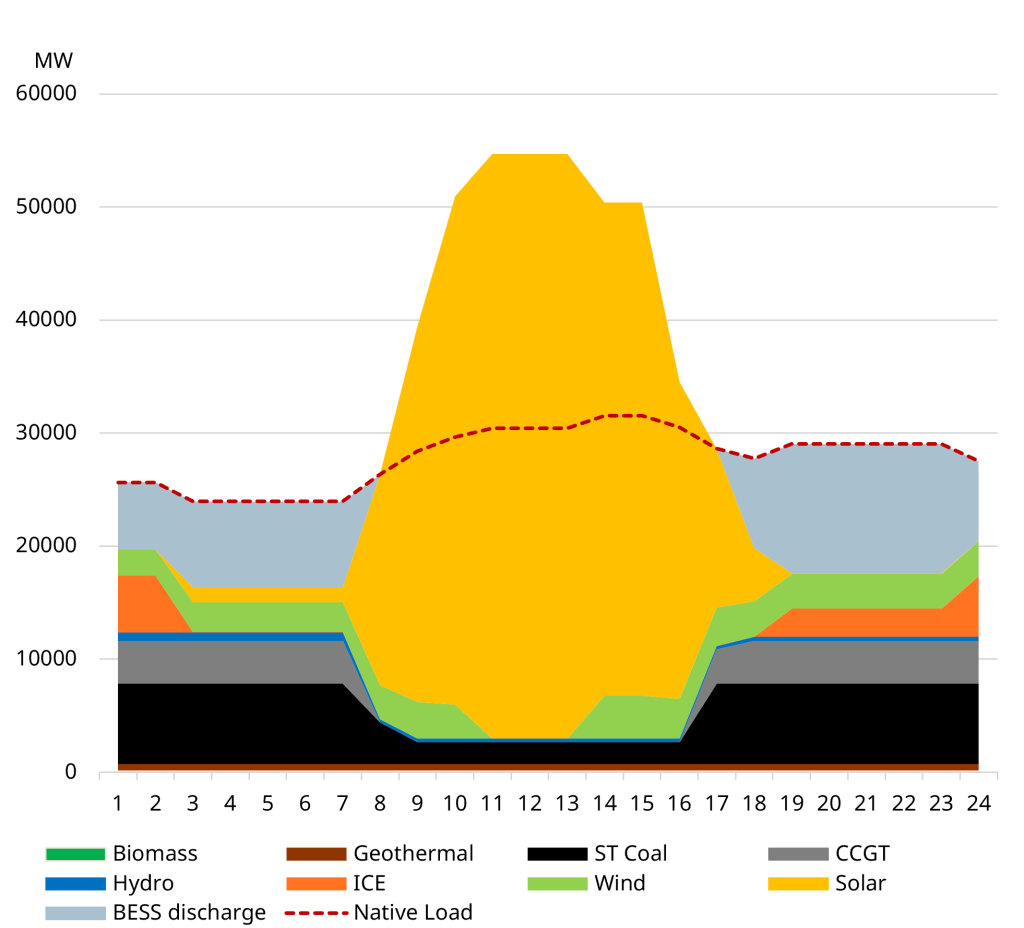
By 2040, the system is characterised by significant midday solar surpluses, followed by an increasingly steep late-afternoon ramp as solar output drops and evening demand rises. The grid needs generation that can sit idle at noon and deliver full output within minutes in the early evening. That is fundamentally different from how traditional baseload plants operate.
A common assumption is that variable renewables, paired with battery storage, can meet all system needs. Battery storage plays a crucial role, particularly for short-duration shifting, absorbing midday solar surplus and discharging it into the early evening peak.
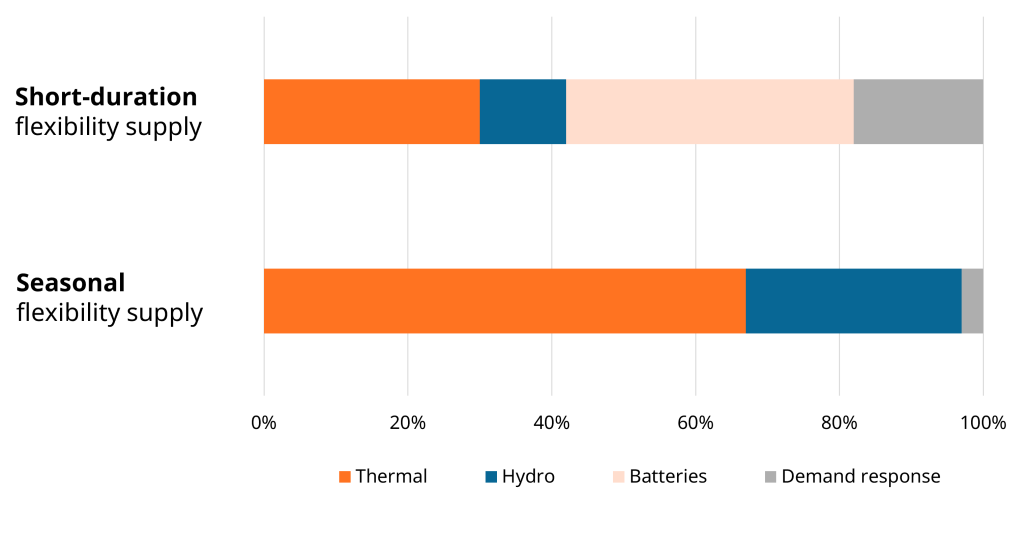
But flexibility is not a single problem with a single solution. It spans a wide range of timescales, from second-by-second frequency response to multi-day and seasonal variability, and different technologies serve different parts of that range. Storage, demand response, and dispatchable thermal generation are complementary, not competing.
The International Energy Agency (IEA) maps this clearly, showing that thermal assets remain necessary even at the short end of the flexibility spectrum.
Flexibility supply by technology
In the Philippines, the flexibility challenge is acute. The Visayas and Mindanao currently have no gas-fired generation or existing gas infrastructure. In both grids, flexibility relies almost entirely on coal and oil.
Even in Luzon, where gas-fired plants exist, they operate as baseload rather than mid-merit capacity. Meanwhile, coal plants are being pushed beyond their technical limits to cover intra-day variability, increasing the risk of forced outages.
The mid-merit auction is a direct response to this lack of flexible capacity across regions, reinforcing why the policy direction is right.
Natural gas is often described as a “transition fuel”. The key question is: transition to what, and under what operating model? Historically, gas plants have operated as baseload to recover capital costs. Gas plants were built and run as baseload, a model that no longer holds in today’s renewable-driven system.
As renewable penetration rises, gas-fired capacity factors are projected to decline sharply, reaching just 5 to 15% by 2050 across much of the region (BloombergNEF).
Declining capacity factor of gas plants
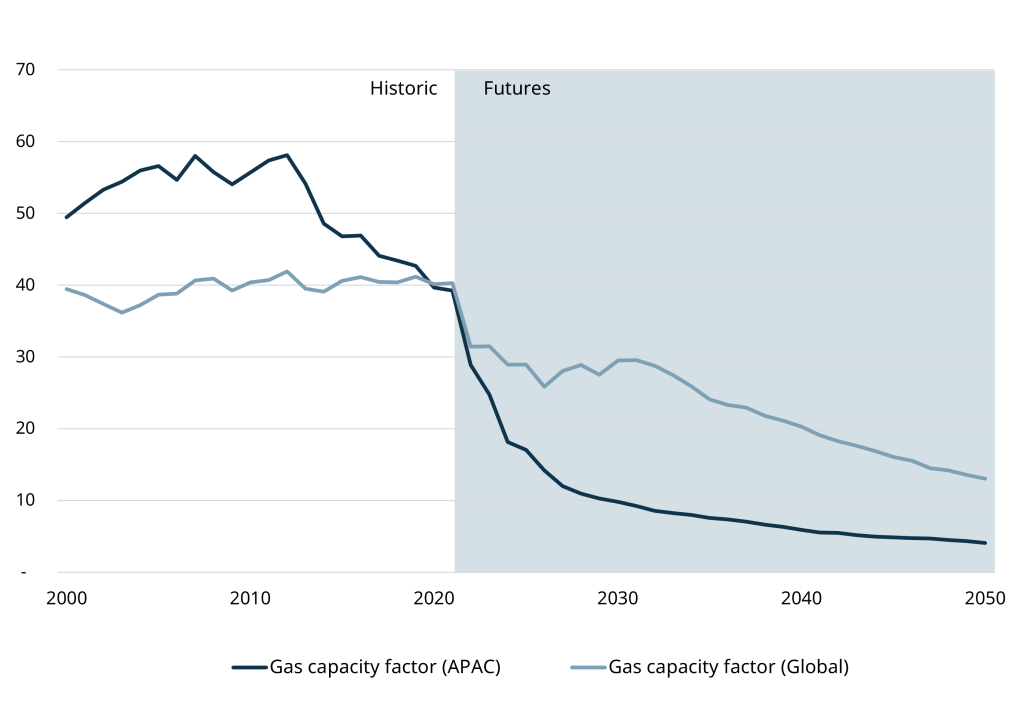
Furthermore, gas prices are volatile and exposed to geopolitical disruptions, as seen in recent years. The higher the utilisation, the greater the fuel cost exposure, and that risk flows through to consumers.
However, gas does not become irrelevant; rather, its role changes. Its value shifts from round-the-clock generation to fast-response flexibility. In that context, the fewer hours a plant runs, the more critical those hours become.
The question, then, is what kind of gas plant actually meets mid-merit requirements?
The draft circular does not prescribe technology. In practice, this means technologies with very different technical capabilities will compete under the same framework. The performance gap between these technologies is significant.
Technical flexibility parameters by technology
| ICE | CCGT | OCGT | |
| Start-up time | 2–5 min | 30 min – 4 h | 5-11 min |
| Start-up cost (USD/MW) | < 1 | 55 | < 1-70 |
| Minimum uptime | < 1 min | 4 h | 10-30 min |
| Minimum downtime | 5 min | 2 h | 30-60 min |
| Minimum load (% of rated capacity) | 10–20% | 20–50% | 20–50% |
| Efficiency (at 100% load) | 45–47% | 52–57% | 35-39% |
| Efficiency (at 50% load) | 45–47% | 47–51% | 27-32% |
| Average ramp rate (% rated capacity/min) | >100% | 2–11% | 8-15% |
The auction framework is well designed. A key question now is whether operational flexibility parameters such as start-up time, minimum load, and ramp rate should be incorporated as qualification or scoring criteria alongside price. Without flexibility parameters, there is a real risk of selecting technologies that appear competitive on paper but fail to deliver the flexibility the system needs.
For independent power producers, the opportunity is real. But the more critical decision is not whether to bid, but what to build. A plant designed for baseload will underperform financially and operationally in a mid-merit role, where the grid calls on it for 15 to 25% of the time but requires a full-power response within minutes.
The Philippines is moving in the right direction. The next step is ensuring the right technology moves with it.

Tri Nguyen
Senior Manager, Market Development, Wärtsilä Energy
With over a decade of experience across Asia and Europe, Tri Nguyen specialises in turning power system models into market strategies for the green energy transition.
As Senior Manager for Market Development, Tri works with governments, international organisations, utilities, and developers to define least-cost pathways towards net-zero power systems and translate them into policy and investment decisions that drive real-world implementation.
A certified PLEXOS modeller, Tri combines deep expertise in power system optimisation with hands-on experience in policy advocacy and commercial origination — helping countries decarbonise by enabling higher shares of renewable energy through system flexibility and hybrid power solutions. He has authored six white papers on power system decarbonisation, won the Best Paper Award at Enlit Asia 2024, and regularly speaks at energy conferences across the region.
Tri holds dual Master’s degrees from Hanken School of Economics and EMLyon Business School. He has lived and worked in Vietnam, France, Finland, and is currently located in Singapore.
*This article as first published on Linkedin/