By 2027, midday power prices may go negative—GTM says hedging will be crucial for survival
- December 26, 2025
- 0
By 2027, negative electricity prices during midday hours may become a regular occurrence, driven by the rapid expansion of solar capacity and increasingly thin daytime demand. This warning comes from John Knorring, CEO and founder of Green Tiger Markets (GTM), who says the Philippines is now following a path already traveled by solar-heavy markets such as Texas and California.
Speaking on Power Podcast, Knorring said GTM’s forward-looking supply–demand modeling indicates that what the market recently experienced as an anomaly is likely to become routine. “Our expectation is that by 2027, there’s going to be a significant number of hours during the middle of the day on a regular basis that are going to be negative,” he said.
Early signals are already visible. The Good Friday negative pricing event earlier this year offered a clear preview of the market’s direction. With many businesses closed and solar generation surging, WESM prices dropped below zero for several hours as the system adjusted to oversupply.

Knorring described the episode as a natural market response rather than a malfunction. Prices fell, he explained, because the system was “forced to balance itself by moving the price down to force some of the thermal generators off the margin.” More importantly, he cautioned that similar conditions will emerge more frequently as additional solar capacity comes online.
The experience mirrors developments in the United States. In Texas, Knorring noted, midday electricity prices once reached USD 150 to 200 per megawatt-hour during peak summer demand. As solar capacity scaled rapidly, those same hours became some of the cheapest on the grid. California went through the same transition earlier. The Philippines, he said, is now at that same inflection point—where midday power has shifted “from being premium to being very, very discounted.”
This change has far-reaching implications for solar developers, electric cooperatives, and retail electricity suppliers (RESes) that remain exposed to spot market volatility. Many merchant solar projects were planned two or three years ago, when daytime prices were stronger and the supply-demand balance tighter. That context has changed.
“The supply-demand balance has changed,” Knorring said, adding that the economics of merchant plants “does not look as good” without mechanisms to manage price risk.
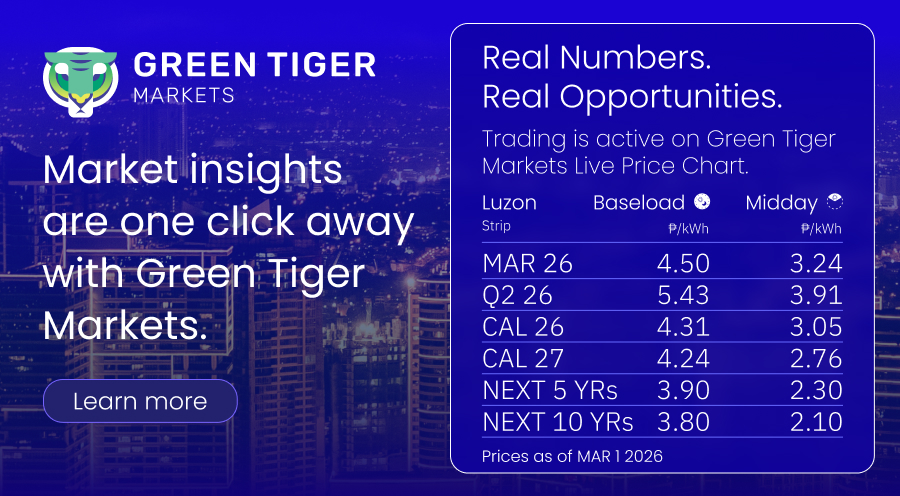
In this environment, hedging is becoming less of a financial tool and more of a requirement for survival. GTM operates the Philippines’ first exchange-based forward electricity market, allowing market participants to hedge exposure through standardized Contracts for Difference (CFDs). These financial instruments settle against WESM prices but do not affect physical power delivery—effectively separating operational decisions from price risk.
As Knorring explained on the podcast, “WESM handles the physical component… and GTM handles the price portion.” This distinction, he argued, is critical as volatility intensifies.
With WESM prices capable of swinging from the Energy Regulatory Commission-set floor of around negative PHP 10 per kilowatt-hour to highs near PHP 35/kWh, unhedged exposure can quickly translate into material financial risk. GTM estimates that roughly 70% of the country’s installed generation capacity is already registered on its platform—an indication that much of the supply side is preparing for sustained volatility.
Knorring emphasized that falling prices themselves are not inherently problematic. “Lower prices aren’t necessarily bad for generators,” he said, as long as companies are actively managing their exposure. The real risk, he warned, lies in assuming that past price patterns will hold in a market that is structurally changing.
Listen to the full Power Podcast episode featuring Green Tiger Markets CEO John Knorring.
With regular negative midday prices now looming, are Philippine developers, cooperatives, and RESes adapting their risk strategies fast enough—or will prolonged exposure to WESM volatility force a painful market reckoning?
Follow Power Philippines on Facebook and LinkedIn or join our Viber community to stay up to date on the latest energy news.