Manila Water shifts East Zone operations to 100% renewable electricity with Aboitiz Power unit
- February 5, 2026
- 0
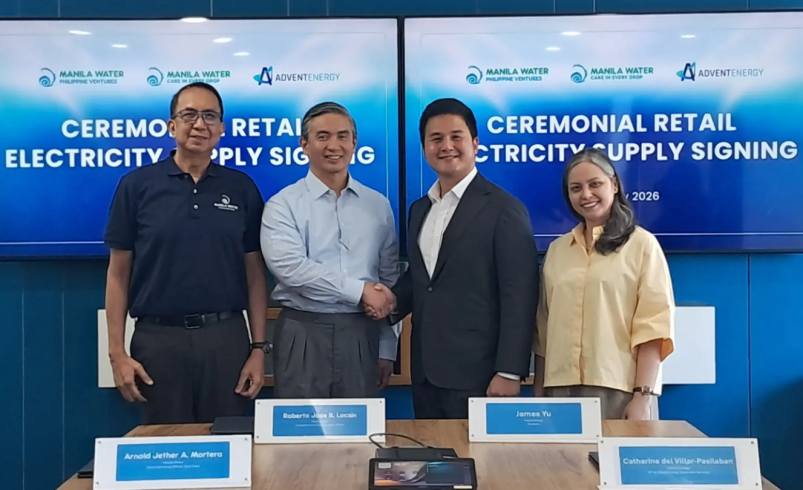
Manila Water Company has transitioned its East Zone operations to 100% renewable electricity supply under a retail power agreement with AdventEnergy, marking a significant shift in how one of the country’s largest water utilities sources its power for its services.
The agreement covers Manila Water’s Enterprise operations, including its East Zone concession in Metro Manila and Rizal. Its non-East Zone business units- such as Cebu Water, Tagum Water, Calbayog Water, Laguna Water, Estate Water, LARC Water, Boracay Water, and South Luzon Water- will be instead supplied with just a 20% renewable energy mix.
Electricity is a major operating cost for water utilities, particularly for treatment and wastewater facilities that require 24/7 power. By directly sourcing renewable electricity through a retail supplier, Manila Water has reduced its carbon footprint while also maintaining affordable and reliable water services for customers.

“We take pride in formalizing this partnership. It truly makes a difference in the lives of our customers knowing that a water utility can work with a partner like AdventEnergy to deliver sustainable solutions that we have worked so hard to pursue,” Manila Water President and CEO Roberto R. Locsin said.
AdventEnergy is the retail electricity arm of Aboitiz Power Corporation. It supplies power to large electricity users under the retail competition and open access framework. AdventEnergy President James Yu said the agreement builds on a partnership that began in 2023.
“We thank Manila Water for a renewed trust in this partnership that started in 2023. Guided by our philosophy of Always-on Innovation, we intend to continue building on our early successes and commit to the pursuit of service excellence for families and communities in need of reliable water services,” Yu said.
The transition to a cleaner power mix follows Manila Water’s earlier adoption of the Energy Regulatory Commission’s retail aggregation program, which now allows large electricity users to combine multiple facilities to qualify for the contestable market. In February 2025, Manila Water consolidated the electricity requirements of 10 wastewater facilities, reaching an average demand of 500 kilowatts.
Through aggregation, companies can bypass traditional distribution utilities and negotiate power supply directly with retail electricity suppliers. This gives them plentiful benefits, including the ability to specify energy sources such as geothermal, solar, or wind. This flexibility enables utilities to manage power costs while simultaneously supporting the renewable energy transition.
Manila Water said the partnership also contributes to the Philippine government’s national decarbonization goals, as the company continues to expand its operations beyond Metro Manila and scale its provincial footprint.
As more utilities turn to retail power sourcing and aggregation mechanisms, will renewable electricity procurement become the standard approach for energy-intensive public services in the Philippines?
Follow Power Philippines on Facebook and LinkedIn or join our Viber community for more updates.