PH renewable energy market seen doubling to USD 42B by 2034
- February 8, 2026
- 0
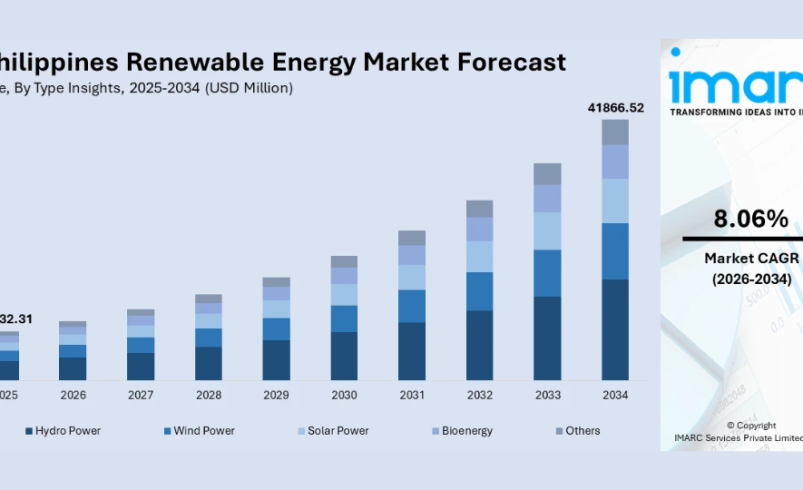
The Philippines’ renewable energy market is projected to nearly double in value to about USD 41.9 billion (approximately PHP 2.45 trillion) by 2034, underscoring the scale of opportunity—and execution risks—facing power producers, investors, and policymakers as the country accelerates its energy transition.
In a report released on February 5, market research firm IMARC Group estimates the sector was valued at USD 20.8 billion (PHP 1.22 trillion) in 2025 and will grow at a compound annual rate of 8.06% from 2026 to 2034, driven by policy support, easing foreign ownership rules, and falling technology costs, particularly for solar.
Hydropower remains the backbone of the country’s renewable mix, accounting for 41% of market share in 2025, supported by long-established large-scale facilities that provide baseload capacity to the grid. Residential consumers, meanwhile, have emerged as the largest end-user segment at 33%, reflecting wider rooftop solar adoption under the net-metering program and heightened sensitivity to electricity prices.

Luzon continues to dominate renewable energy deployment, capturing 59% of the market, due to concentrated demand from industrial hubs, stronger transmission infrastructure, and the bulk of committed renewable projects.
IMARC said the investment environment has shifted materially following the removal of foreign ownership restrictions in solar, wind, hydro, and ocean energy projects, enabling greater participation by international developers. This has intensified competition with local conglomerates, particularly in projects awarded through the Department of Energy’s green energy auctions.
Recent large-scale developments illustrate the pace of expansion. These include the USD 3.4-billion (PHP 200 billion) MTerra Solar Project in Nueva Ecija and Bulacan, which integrates solar generation with battery energy storage and is designed to supply power to more than two million homes once completed. Government-led auctions have also continued to anchor new capacity, with the fourth Green Energy Auction launched in 2025 targeting 9.38 gigawatts across solar, wind, floating solar, and hybrid projects.
Despite the growth outlook, IMARC flagged transmission bottlenecks, the country’s fragmented archipelagic grid, and persistently high electricity prices as key challenges that could limit renewable integration and affect project economics if not addressed in parallel with capacity additions.
Over the medium term, the firm said continued policy clarity, grid upgrades, and hybrid solutions—such as pairing solar with storage or existing hydropower assets—will be critical in translating ambitious national targets into bankable, on-the-ground projects.
IMARC Group is a global market research company that provides data-driven insights and consulting services across industries, including energy. Its renewable energy reports combine primary interviews, secondary research, and market modeling to deliver actionable forecasts for investors, developers, and policymakers.
How do you see grid constraints and auction design shaping the next phase of renewable energy investments in the Philippines? Join the discussion.
Follow Power Philippines on Facebook and LinkedIn or join our Viber community for more updates.