Regulatory gaps emerging as EV rollout accelerates, says ACEN CEO
- March 26, 2026
- 0
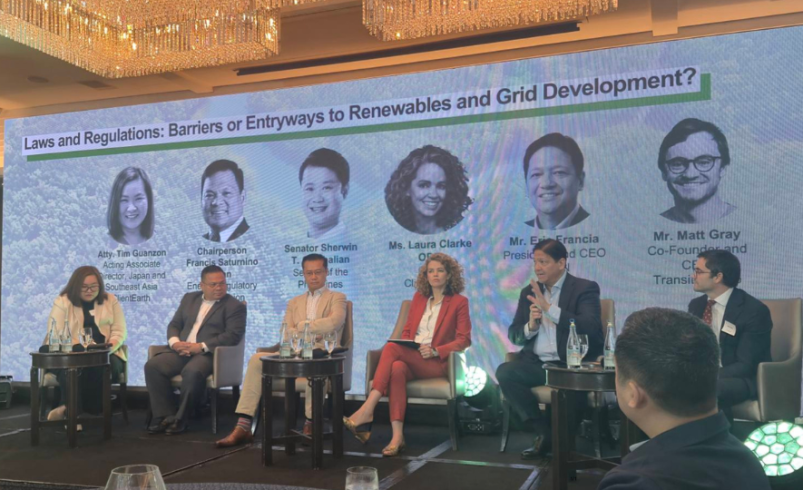
Electric vehicles (EVs) could play a central role in reshaping electricity demand and accelerating the Philippines’ energy transition, but regulators must address emerging cost distortions in the power system, ACEN President and CEO Eric Francia said during a recent panel discussion at a forum titled “The Role of the Law in Accelerating the Energy Transition in the Philippines,” held on March 25.
ACEN Corp., part of the Ayala Group, focuses on clean energy generation but its affiliated mobility platform, ACMobility—the official distributor of BYD passenger electric vehicles in the Philippines—has been expanding the country’s EV charging infrastructure, targeting hundreds of charging points nationwide and acquiring the Evro network to streamline access for EV drivers.
“AC Mobility, our sister company, and other companies like Shell and Meralco, are rolling out these EV charging stations nationwide. We expect to be more than 1 ,000 charge points for AC Mobility alone. Last week we signed an agreement with Makati LGU where we are providing renewable energy and charging stations all around Makati,” the ACEN chief said.

Francia pointed to the growing convergence of rooftop solar, battery storage, and EV adoption at the household level, describing it as an inevitable shift that policymakers should enable rather than resist.
“People will switch. This is the COVID moment of GCash or fintech,” Francia said, referring to the rapid uptake of distributed energy technologies. “Let’s embrace this and fix our regulations to enable this, not to stop this,” he added.
Francia noted that EVs, alongside home solar and storage systems, could significantly reduce reliance on the grid for some consumers. Drawing from personal experience, Francia said, “I do have ample solar rooftop, and I have an electric vehicle. I don’t need to route out those stations,” adding that he plans to install battery storage to become “somewhat self-sufficient.”
However, he warned that widespread adoption of these technologies could create structural challenges for distribution utilities.
“If everyone did this, where are they going to get their return on investment?” Francia said, referring to utilities potentially losing revenue as more consumers generate and store their own power.
He cautioned that without regulatory adjustments, the system could lead to inequities where consumers who cannot afford EVs or solar installations end up shouldering the cost of maintaining grid infrastructure.
“The problem is those who don’t switch will bear the cost of this fixed asset,” he said.
Francia also highlighted EVs as a critical component in managing electricity demand and improving grid flexibility, noting that EV batteries can serve as distributed storage assets to help absorb excess power and stabilize the grid.
Panelists echoed this, pointing to international models where utilities subsidize EV adoption in exchange for access to battery storage for energy trading and grid balancing.
Such models are already being tested in markets with vehicle-to-grid (V2G) capabilities, where EVs can discharge electricity back into the grid during peak demand. Pilot programs in countries such as Denmark and the United States have shown that EV fleets can support grid stability while generating additional income for owners, illustrating the potential of EVs to function as decentralized energy storage.
In the Philippine context, Francia emphasized that enabling EV adoption—alongside rooftop solar—should be paired with reforms in pricing, cost recovery, and market design to prevent distortions.
He also underscored the need to expand access to renewable energy benefits beyond affluent households. “Let the homes have benefits, especially the poorer households… to benefit from renewable energy,” he said, advocating for lowering participation thresholds in green energy programs.
The discussion comes as policymakers continue implementing the Electric Vehicle Industry Development Act (RA 11697) and its roadmap to accelerate EV adoption. Under the law, government agencies are mandated to support the construction of charging infrastructure and require establishments with EV charging stations to designate parking spaces for electric vehicles, reinforcing non-fiscal support for EV users.
The national EV roadmap also encourages distribution utilities to include EV charging stations in their planning, signaling broader policy support for expanded charging access and infrastructure integration to help scale EV use in the country.
Francia pointed to an opportunity and a disruption for the power sector, urging closer coordination between regulators and industry players.
“We want to empower or democratize renewables into the household and make it open and competitive but we also want to be sensitive to the risks and challenges of a distribution business,” he said.
How should regulators balance rapid EV adoption with grid sustainability and fair cost allocation? Join the discussion.
Follow Power Philippines on Facebook and LinkedIn or join our Viber community for more updates.