
Solar surge halts fossil electricity growth globally in 2025 –Ember
- April 21, 2026
- 0
Clean energy met all global electricity demand growth in 2025 and effectively halted the expansion of fossil fuel generation, according to a report by global energy think tank Ember.
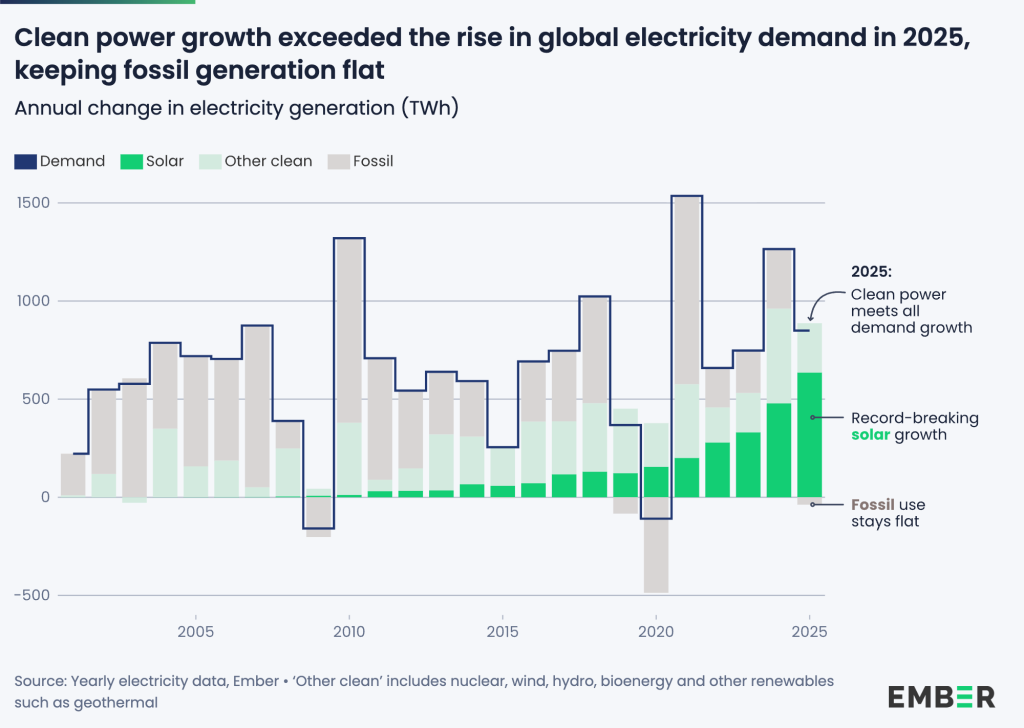
In its seventh annual Global Electricity Review, Ember found that clean power generation rose by 887 terawatt-hours (TWh), slightly exceeding global demand growth of 849 TWh. As a result, fossil fuel generation fell by 0.2%, marking only the fifth time this century that fossil electricity has not increased year-on-year.
Solar power was the dominant driver of the shift, with global output rising by 636 TWh in 2025, a 30% increase from the previous year.

“We have firmly entered the era of clean growth,” said Ember managing director Aditya Lolla. “Clean energy is now scaling fast enough to absorb rising global electricity demand, keeping fossil generation flat before its inevitable decline. The momentum we are seeing is no longer just an ambition, it is becoming a structural reality.”
“Solar has been the dominant driver of change in the global power system. Along with battery storage, it is opening a path to fast-scaling, round-the-clock clean power,” Lolla added.
Solar alone met 75% of global electricity demand growth in 2025. When combined with wind, renewables accounted for 99% of the increase, leaving other sources to contribute almost nothing to net demand growth.
As clean generation expanded, global electricity generation from coal fell by 63 TWh, pushing coal’s share down to 33%, while renewables rose to 34%, overtaking coal for the first time in modern history.
According to Ember, the shift was driven largely by China and India, both of which recorded declines in fossil fuel generation for the first time this century. China’s fossil generation fell by 56 TWh, while India’s dropped by 52 TWh.
In China, rapid clean energy expansion fully met rising electricity demand, while in India, strong renewable growth and hydro output helped reduce fossil reliance despite continued demand increases.
“China’s rapid expansion of solar and wind is meeting rising electricity demand at home while influencing the global electricity transition,” said International Society for Energy Transition Studies president Xunpeng Shi.
“China’s progress is showing how growing demand can increasingly be met with clean electricity rather than fossil fuels,” Shi added.
Storage technologies are also emerging as a key enabler of higher renewable penetration. Enough battery capacity was installed in 2025 to shift 14% of newly added solar generation from midday peaks into other hours of the day, improving system flexibility.
“Solar PV is the cheapest way to produce electricity in most of the world, and rapidly falling battery costs have made solar and batteries an economic way to provide round-the-clock electricity in many countries,” said Energy Transitions Commission co-chair Adair Turner.
“This is an unstoppable revolution driven by fundamentally superior technologies,” Turner added.
The report noted that the shift toward clean electricity is also reshaping energy security dynamics, reducing exposure to fossil fuel imports while meeting rising electricity demand.
“Clean energy is rapidly redefining the foundation of energy security in a volatile world,” Lolla said. “It is already helping countries reduce exposure to fossil fuel imports and costs while meeting rising electricity demand. The next step is to modernise grids and regulatory frameworks so power systems are ready to handle this new reality.”
How should the Philippines position its power sector in response to the accelerating global shift toward clean electricity?
Follow Power Philippines on Facebook and LinkedIn or join our Viber community for more updates.