President Marcos to push energy security, deeper Japan ties in state visit
- May 20, 2026
- 0
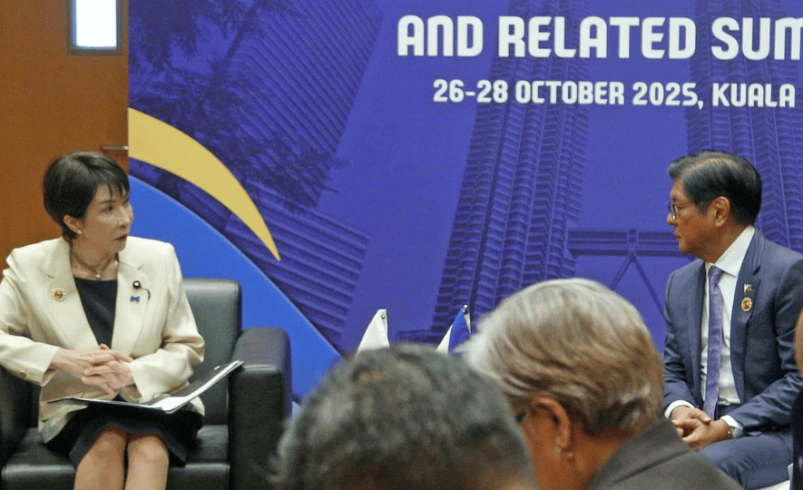
In photo: President Ferdinand “Bongbong” Marcos Jr. meets with Japanese Prime Minister Sanae Takaichi during a bilateral session at the 47th ASEAN Summit in Kuala Lumpur, Malaysia in October. /Photo credit
President Ferdinand R. Marcos Jr. will travel to Japan on May 26 to 29 for a four-day State Visit that is expected to place energy security and regional supply resilience at the center of discussions with Tokyo.
The visit comes as Manila and Tokyo mark the 70th year of diplomatic relations, with both sides moving to further expand cooperation in strategic sectors, including energy, maritime security, and economic resilience.
In an interview with Japanese media in Malacañang, Ferdinand Marcos Jr. underscored Japan’s growing role in addressing energy supply challenges faced by the Philippines and the wider Indo-Pacific region.

“We will again try to engage Japan and to see how it will work together with Japan, as Japan has now taken a more active role when it comes to the subject of energy and the energy supply,” Marcos said.
He added that Japan has already played a key role in supporting Philippine energy security efforts.
“We are actually very grateful to Japan because Japan has been of great assistance to us in trying to find different solutions for the supply of the different kinds of fuel. And that has become a critical part of our policy,” he said.
Energy cooperation is expected to feature prominently in Marcos’ summit meeting with Japanese Prime Minister Sanae Takaichi, alongside discussions on maritime security and so-called “coercive acts” in Indo-Pacific waters, as well as broader bilateral economic cooperation.
The energy agenda builds on regional discussions during the 48th ASEAN Summit (48th ASEAN Summit Cebu), where leaders explored measures to strengthen electricity and fuel security, including potential common infrastructure and reserve mechanisms.
A key focal point of the upcoming talks is Japan’s proposed response mechanism under the Partnership on Wide Energy and Resources Resilience (POWERR Asia), which could provide up to USD 10 billion in assistance for participating Asian economies.
The initiative, launched by Takaichi in April, is designed to support crude oil access, critical mineral diversification, and the development of zero-emission supply chains aimed at reducing exposure to external supply shocks
“And we will again try to get more clarity on what the POWERR Asia system that has been proposed by Prime Minister Takaichi. What does it mean in terms of linkages between our different countries, between the Philippines and Japan, and between all of the countries in the region?” Marcos said
“So it is extensively used for supply procurement, for supply chain maintenance, and for crude oil stockpiling capacity augmentation in Asia,” he added.
The President also expressed interest in expanding cooperation on renewable energy deployment as part of a broader regional strategy to enhance long-term energy security amid geopolitical uncertainty.
How could deeper Philippines–Japan energy cooperation, particularly under POWERR Asia, reshape the country’s fuel security and transition roadmap in the near term?
Follow Power Philippines on Facebook and LinkedIn or join our Viber community for more news and updates on the Philippine energy sector.