BESS could cut PH power costs by up to USD 275M annually by 2030 —FESSIA
- May 20, 2026
- 0
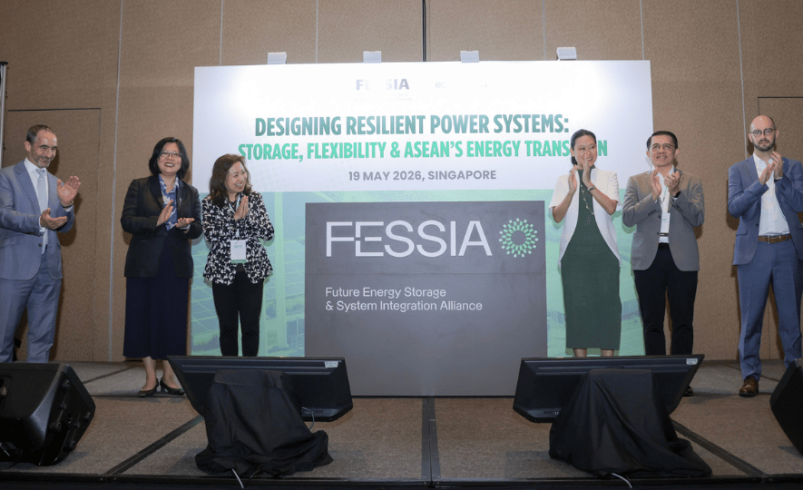
In photo: (L-R) Host of Cleaning Up Michael Liebreich, Liming Qiao (FESSIA), Helena Li (Trinasolar), Hum Wei Mei (Carbon Trust), Tan Yoong Heng (Arup), and Dr. Matthew Rowe (DNV Energy Systems)
A new industry report is pointing to battery energy storage systems (BESS) as a near-term cost and flexibility lever for the Philippine power sector, particularly through ancillary services that could materially reduce system costs and unlock multi-billion-dollar value in solar integration.
The Future Energy Storage & System Integration Alliance (FESSIA), in its inaugural report “Unlocking the Role of Utility-scale Battery Energy Storage Systems (BESS) in ASEAN electricity markets,” said the Philippines could see “ancillary services… reduce system costs by up to USD 275 million annually and unlock USD 2.25 billion in Solar + BESS revenues by 2030.”

The report was launched during Temasek’s Ecosperity Week 2026 in Singapore and developed in collaboration with DNV, examining utility-scale storage deployment pathways across ASEAN, with the Philippines and Vietnam used as key case studies.
FESSIA said the region’s energy transition challenge is increasingly centered on system flexibility rather than generation buildout alone, noting that ASEAN’s installed BESS capacity remains at around 1.4 gigawatts.
As variable renewable energy expands, the group stressed that storage will play a larger role in maintaining grid stability, with use cases spanning ancillary services, energy shifting, renewable hybridization, and transmission and distribution deferral.
The report also highlighted that “ancillary services currently provide the strongest economic case for BESS in Vietnam and the Philippines,” while hybrid renewable-plus-storage projects are already commercially viable in both markets.
It added that “revenue stacking will be key to improving project bankability and accelerating deployment,” particularly in emerging markets where multiple revenue streams are needed to support investment cases.
While BESS technology costs have fallen by nearly 90% over the past decade, FESSIA said the binding constraint across ASEAN is no longer technology readiness but “market readiness.”
“The energy transition is entering a new phase where flexibility must become central to power-system planning, operations, and market design,:” Liming Qiao, CEO and Founder of FESSIA, said. “The first phase of the transition is focused on deploying renewable energy. The last 10% will depend on whether power systems can integrate renewables reliably at scale.”
“BESS should not be viewed simply as a power bank. Its real value lies in the broader flexibility and system services it can provide, including ancillary services, energy shifting, renewable energy hybridization, and transmission and distribution deferral,” he added.
DNV Energy Systems’ Power Grids Asia Pacific Director Dr. Matthew Rowe said regulatory and market frameworks will be critical in unlocking storage investment in the region.
“Accelerating the energy transition across ASEAN requires electricity markets and regulatory frameworks to evolve to fully realize the system value that BESS can provide,” he said.
He added that clearer operational rules and mechanisms recognizing storage flexibility are needed in markets such as the Philippines and Vietnam, with “revenue stacking offering additional upside by strengthening project economics and reducing investment risk.”
FESSIA also formally introduced its inaugural members, including Trinasolar, sodium-ion storage developer PHENOGY, Arup, DNV, and The Carbon Trust.
The alliance said its objective is to support the development of market and policy frameworks needed to scale energy storage deployment across Southeast Asia, including the Philippines.
The report is currently undergoing peer review and will be released publicly in the coming period.
What policy or market design changes do you think are most urgent to unlock large-scale BESS deployment in the Philippines—ancillary services reform, revenue stacking mechanisms, or clearer storage market rules?
Follow Power Philippines on Facebook and LinkedIn or join our Viber community for more news and updates on the Philippine energy sector.