Optimizing the Design of Natural Ester Liquid-filled Transformers for a More Flexible Power Grid
- July 23, 2026
- 0
By Kin Yu LAM, Cargi Bioindustrial, Southeast Asia and Pacific
Abstract
With the continuing increase in electricity demand and the rising need to integrate renewable energy sources and battery storage systems, power grids are increasingly required to cope with overloading, and the intermittent nature of power supply [1].

Traditionally, transformers’ ratings are determined by the peak loading demand. Loading above nameplate is considered a risky practice, not only for the accelerated degradation of the paper insulation, but also because of the limited tolerance of mineral oil to high temperature and the possibility of bubble formation. Based on the normal “duck curve” representing the daily loading profile of power network as recorded from smart meters in different continents, a typical peak loading demand is about three or four times the daily or yearly average. In other words, a transformer with nameplate capacity matching the peak demand will experience an average load factor in the range of 25% to 33%. As the optimized efficiency of transformers is normally around 50% of their nominal rating, based on the balance between no-load and load losses, the lower average load factor would lead to higher system loss.
When thermally upgraded Kraft (TUK) paper is used in transformers with natural ester dielectric liquid, it can be classified as a high temperature insulation system with 140 thermal class, 20 °C higher than that with mineral oil [2]. The higher temperature limits allow transformers to hold an additional loading capacity when rated based on the conventional winding temperature [3]. Since the risk of bubble formation [4] and accelerated paper/liquid degradation is mitigated through the continuous paper drying action of the more thermally stable natural ester liquid [5], this additional above nameplate capacity can be utilized without increasing the risk of transformer failure. One of the greatest benefits of using natural ester dielectric liquid is therefore about breaking the paradigm of having to match the transformer rated capacity to the expected peak demand. From an operational perspective, it means that utilities and power network owners will have additional headroom to manage peak demand or unexpected loading increase without the immediate need to upgrade or replace existing assets.
Drawing on proven industrial practices and key findings from two major utilities in the Philippines and the USA, this article reviews the different ways of utilizing the additional loading capacity in natural ester liquid-filled transformers. It also discusses, in practical terms, how utilities and end users would have greater flexibility to decide on the specification of transformers to optimize the various aspects including asset life, loading reserve, equipment footprint, system loss, etc., according to the individual’s requirements.
Utilizing the higher thermal class of natural ester liquid-filled transformers
As utility companies and power system operators strive to improve power network reliability and resilience while trying to optimize equipment utilization, using conventional mineral oil-filled transformers with limited loading capacity is often considered a major constraint. This is particularly the case for those utilities facing the challenges of rapid demand growth and limited capital for system upgrade. In addition, there are also significant “hidden costs” associated with the use of oversized mineral oil-filled transformers to mitigate failure risks and fire hazards pertaining to adjacent equipment, environment and the community.
Since its introduction more than two decades ago as a biodegradable, less flammable, alternative insulating liquid to mineral oil [6-7], natural ester has been increasingly recognized for its ability in improving equipment reliability, lifespan and loading capacity as well [3,5,8-9]. A consequence of its significantly higher fire point and thermal stability, natural ester liquid’s maximum operating temperature is about 25 °C higher than conventional mineral oil [2]. Furthermore, its unique ability in removing moisture through absorption and hydrolysis, as well as in undergoing transesterification [10], means natural ester liquid can also retard the degradation of cellulose paper insulation as shown in the IEEE accelerated aging tests [11].
Based on the loading curves derived from the results of the accelerated thermal aging test (Figure 1) [2], the twin benefits of natural ester liquid in prolonging the insulation life and increasing the thermal class of TUK paper can be realized in the following ways. At point A in Figure 1 where the hottest spot winding temperature is the same as the equivalent conventional mineral oil-filled transformer, the insulation life can be extended by about 7.4 times. At the other end, at point B, where the hottest spot temperature is 20 °C higher, the natural ester-filled transformer would have an additional loading capacity of, at least, 20% while keeping insulation lifespan to nominal, based on the conservative estimation in the IEEE loading guide [12]. In between point A and B, transformer designers would have the feasibility to define the appropriate winding temperature limits and nameplate ratings to optimize equipment utilization, system loss, cost of ownership, etc., based on the requirements and constraints for the different applications.
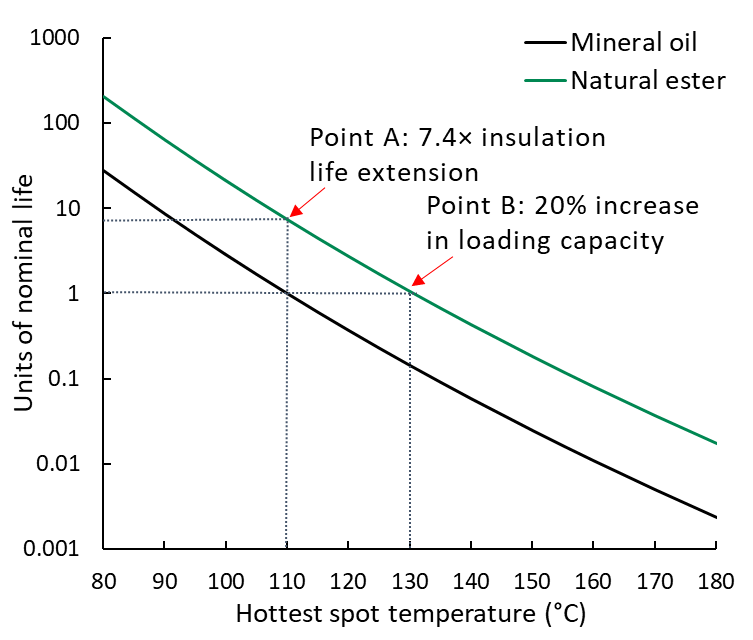
Fig. 1. TUK paper insulation life as function of the hottest spot winding temperature
What follows is a description of the different ways in which the additional capacity of natural ester liquid-filled transformers with TUK paper can be utilized based on the application and end-users’ requirements. [8]:
Conventional loading. The rating of the natural ester liquid-filled transformer is the same as the equivalent mineral oil-filled unit with conventional average winding temperature rise (AWR) and hottest spot temperature at 65 °C and 110 °C, respectively. The main objective of this approach is to maximize insulation life and equipment reliability.
Compact loading. The natural ester liquid-filled transformer is rated at higher AWR of 75 °C or 85 °C. This approach aims to optimize transformer footprint and weight and is especially suited for applications with space constraints.
Sustainable peak loading or dual-rated capacity. The natural ester liquid-filled transformer is rated at conventional AWR of 65 °C and the above nameplate capacity is used to match the rating of the next higher kVA/MVA level. The approach’s key objective is to utilize the additional loading capacity to cope with the peak loading demand beyond the nameplate rating. This approach has been widely used for distribution networks, renewable energy installations, battery storage systems, data centers, etc., in which the loading profile tends to be intermittent and changeable.
As shown in Table 1, which summarizes the typical characteristics of the different design approaches as mentioned above, end users are not restricted in how they utilize the benefits of natural ester liquid-filled transformers. Instead, they can select the most suitable design option based on their needs and priority to get the optimal balance of longer asset life, higher loading capacity, smaller equipment footprint, and lower initial cost, etc.
Table 1. Common design approaches for natural ester- liquid-filled transformers with TUK paper and the typical characteristics with respect to conventional design of mineral oil-filled units.
| Parameter | Conventional loading | Compact loading | Sustainable peak loading |
| AWR (°C) | 65 | 75 or 85 | 65 |
| Additional loading capacity | 20-50% | 5-20% | 0-5% |
| Overloading capacity | Highest | Higher | High |
| Transformer life | ~1.5x | ~1.33x | Minimum 1x |
| Initial cost | 5-15% higher | Comparable | Lower |
| Electrical losses | No change | Comparable | Comparable/lower |
| Footprint | No change | Smaller | Smallest |
| Applications | Power, distribution transformers | Large power, distribution transformers | Power, distribution transformers of relatively low average load |
As illustrated from the following case studies involving major utilities in the Philippines and the US, tangible benefits including significant lifecycle asset cost saving can be achieved with the use of natural ester liquid-filled transformers based on the different design approaches.
Cost benefit analysis on insulation life extension from conventional loading
The cost benefits from the longer lifespan of natural ester liquid-filled transformers can be illustrated in a real-world example from the Philippines. In an extensive study conducted by a major utility, replacement rates for 12,426 mineral oil-filled pole-mounted transformers replaced over the 3 years period from 2017-2019 were analyzed [13]. For each of the different replacement modes, the benefits of using natural ester insulating liquid in reducing dielectric and thermal failure were estimated based on the slower paper aging rate and longer insulation life as shown in the thermal aging test. For the planned replacement due to load splitting and uprating (non-failure related), the replacement rate for natural ester liquid-filled transformers is estimated to be about 50% lower than mineral oil-filled units due to the higher loading capacity afforded by the higher thermal class of the insulation system.
As shown in Table 2, the overall replacement rate of natural ester liquid-filled transformers is about 4.56% verses 6.72% for mineral oil-filled units. As the life expectancy of mineral oil-filled pole-mounted transformers is 30 years according to the utility’s asset management system, the corresponding life expectancy for natural ester liquid-filled transformers would be about 44.2 years based on the lower replacement rate.
Table 2. Replacement rate of mineral oil and natural ester liquid-filled pole mounted transformers based on the study carried out by a major utility in the Philippines.
| Replacement mode | Percentage of replacement i | Impact of natural ester on replacement (a) ii | Reduction in degradation rate (b) iii | Replacement rate of mineral oil transformers i | Replacement rate of natural ester transformers k |
| Overloading (thermal) | 24.88% | 100% | 4.00 | 1.67% | 0.42% |
| Contamination (physical chemistry) | 19.54% | 0% | 1 | 1.31% | 1.31% |
| Internal fault (dielectric) | 12.49% | 85% | 7.40 | 0.84% | 0.22% |
| Primary voltage problem | 11.13% | 0% | 1 | 0.75% | 0.75% |
| Foreign objects | 7.28% | 0% | 1 | 0.49% | 0.49% |
| Accessories problems | 5.70% | 0% | 1 | 0.38% | 0.38% |
| General aging | 5.04% | 0% | 1 | 0.34% | 0.34% |
| Other faults | 5.16% | 0% | 1 | 0.35% | 0.35% |
| Load splitting | 3.51% | 50% | – | 0.24% | 0.12% |
| Uprating | 5.29% | 50% | – | 0.36% | 0.18% |
| Total | 100.00% | – | – | 6.72% | 4.56% |
To evaluate the lifecycle cost of natural ester liquid-filled transformers against that of the equivalent mineral oil-filled units, the net present value (NPV) of the transformer replacement costs over the lifespan of the natural ester liquid-filled transformer was calculated according to Equation (1).
C NPV=t=0nC/[(1+r)^t] (1)
Where C (NPV) is the net present value of the transformer lifecycle cost, C is the cash outflow for the purchase and replacement of transformer, r is the discount rate and t is the lifespan of the natural ester liquid-filled transformer.
With the assumption that its initial cost is 15% higher than the equivalent mineral oil-filled transformer, the lifecycle cost saving of natural ester liquid-filled transformer over the equivalent mineral oil-filled units can be derived against its life expectancy using the utility’s discount rate of 3.65% as shown in Figure 2. Applying the expected lifespan of 44.2 years as determined from the replacement rate analysis as described earlier, the lifecycle cost saving is estimated to be about 6.78% in this case. For the utilities, this saving would effectively translate into lower capital layout over time due to fewer transformer replacements and the longer asset life.
It should be noted that only the capital cost of transformers is considered in this study. Due to natural ester’s capability in continuously absorbing moisture from paper insulation and chemically removing it through the hydrolysis reaction [10], maintenance cost required for the purification of dielectric liquid and the drying of transformer coils over the lifespan of the asset is often much reduced. Therefore, if the maintenance cost is to be included, it is likely to yield much higher lifecycle ownership cost saving for natural ester liquid-filled transformers.
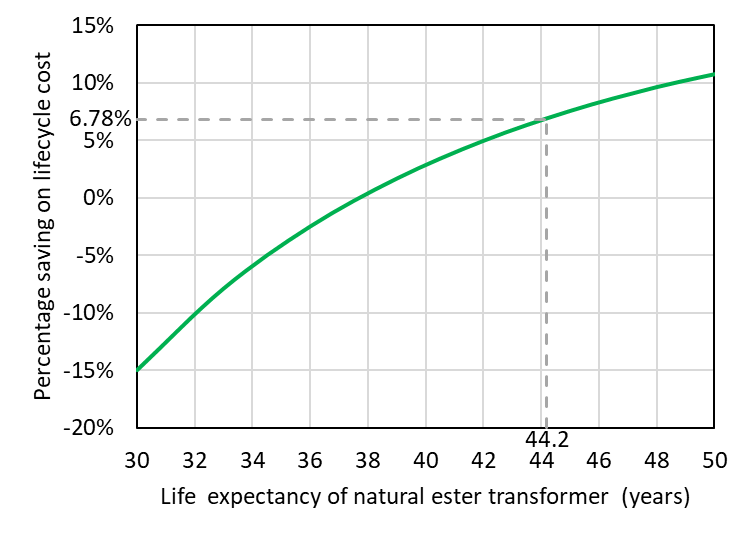
Fig. 2. Lifecycle cost saving of natural ester liquid-filled transformers against its life expectancy based on 15% higher initial cost and the utility’s discount factor at 3.65%
Cost benefit analysis on energy efficiency from sustainable peak loading
In another study conducted with an American utility, the benefits of using natural ester liquid-filled transformers based on the sustainable peak loading approach were evaluated in terms of energy efficiency and overall cost of ownership [8].
Since transformers are usually not designed based on temperature limits alone, the feasibility of having maximum hottest spot temperature 15-20 °C higher would normally allow 35-50% increase in loading capacity for natural ester liquid-filled transformers without significant change to the critical parts. As described earlier, a sustainable peak loading transformer is essentially about utilizing this additional loading capacity to match the maximum loading of a conventional transformer one nominal rating grade higher.
Natural ester liquid-filled transformers are designed to operate under sustainable peak loading condition with the transformer top oil and the hottest spot temperatures within the limits for the higher liquid and paper insulation thermal classes when subjected to the specific loading profiles.
As shown in Table 3, based on this study a 15 kVA and a 75 kVA natural ester liquid-filled transformer rated at 65 °C AWR can withstand the peak load for a 25 kVA and a 100 kVA mineral oil-filled unit, respectively, without exceeding the higher temperature limits.
Table 3. Comparative study on natural ester liquid-filled transformers designed for sustainable peak loading against mineral oil-filled units of conventional design
| Parameter | 25 kVA mineral oil-filled transformer | 15 kVA natural ester liquid filled- transformer | 100 kVA mineral oil-filled transformer | 75 kVA natural ester liquid-filled transformer |
| Average load | 9.65% | 16.08% | 20.93% | 27.9% |
| Peak load | 72.2% | 120.33% | 143.65% | 191.54% |
| Top oil temperature (°C) | 58.88 | 63.25 | 69.41 | 76.97 |
| Hottest spot temperature (°C) | 62.88 | 72.3 | 83.51 | 105.41 |
| No-load loss (W) | 69 | 47 | 194 | 141 |
| Average load loss (W) | 4.92 | 9.53 | 54.62 | 73.45 |
| Energy dissipated per year (kWh) | 647.54 | 495.20 | 2,177.91 | 1,878.58 |
More importantly, the comparative results in Table 3 also show that at average load factor below 30% of the rated capacity, the system loss from the sustainable peak loading natural ester liquid-filled transformers is significantly lower, as the lower no-load loss of these more compact units outstrips the higher average load loss.
From a cost of ownership perspective, apart from the lower initial equipment cost, the saving due to the lower system loss of the sustainable peak loading natural ester liquid-filled transformers at relatively low load factor could be even more significant over the lifespan of the assets (Table 4).
In summary, the sustainable peak loading design approach would effectively enable utilities and end users to safely deploy a smaller transformer to handle the same peak demand, while improving equipment utilization and reducing overall system loss.
Table 4. Ownership cost of sustainable peak loading natural ester liquid-filled transformers as compared to conventional mineral oil-filled units
| Ownership cost parameter | 25 kVA mineral oil-filled transformer | 15 kVA natural ester liquid filled- transformer | 100 kVA mineral oil-filled transformer | 75 kVA natural ester liquid-filled transformer |
| Initial transformer cost (US$) | 2,333 | 1,635 | 5,537 | 4,651 |
| Cost of losses per year (US$) i | 78 | 59 | 664 | 558 |
| Saving on cost of losses (US$) | 19 | 106 | ||
| % Saving on cost of losses | 24% | 16% | ||
Optimizing transformer design for individual’s needs and priorities
The case studies described earlier thus highlight two distinctive approaches in deploying natural ester liquid-filled transformers to deliver tangible ownership cost savings over the conventional mineral oil-filled units. While the conventional loading approach would allow end users to maximize savings in terms of the net present value of the asset cost over the prolonged transformer life, the sustainable peak loading approach would help reduce initial capital cost and improve equipment utilization and energy efficiency for transformers that are subject to changeable loading profile with high peak load but relatively low average load factor.
As illustrated in the decision tree for deciding the optimized design approach (Figure 3), ultimately one of the biggest benefits of natural ester dielectric liquid lies in its ability to provide utilities and power system owners with the flexibility to adapt to evolving grid demands while optimizing reliability, cost and performance. Whether it is to cope with the rapid growth in power consumption, or to suit the fluctuating loading from renewable energy sources and battery storage systems, it is no doubt that natural ester liquid-filled transformers would be preferred choice to enhance the power grid of the future.

Fig 3. Decision tree for the optimized way to deploy natural ester liquid-filled transformers
References
About the author:

Kin Yu Lam serves as the Regional Application Engineering Leader for Cargill Bioindustrial’s Power Systems business in Southeast Asia and the Pacific. With extensive expertise in natural ester dielectric fluids, he is a strong advocate for transformer and power system solutions that enhance safety, sustainability, reliability, and operational performance. Through his work with utilities, manufacturers, and industry partners, he helps drive the adoption of innovative technologies that extend asset life and support a more resilient power grid. Kin Yu is a recognized thought leader, published author, and frequent speaker at regional and global technical conferences.