Groups call for safer infrastructure, clearer policies for LEV adoption in PH
- March 2, 2026
- 0
Climate advocates, transport workers, industry groups, and government agencies are pushing to integrate light electric vehicles (LEVs) as part of efforts to advance low-carbon mobility in the Philippines, highlighting the need for safer infrastructure and clearer policies.
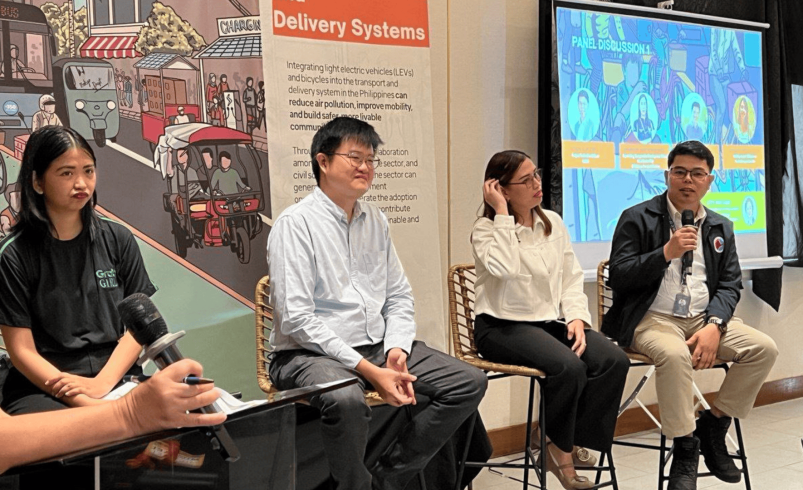
This was raised during a two-panel discussion, titled “Life with LEVs: Powering the Future of Low Carbon Mobility,” organized by climate advocacy group 350 Pilipinas. Held on Friday, February 27, at Harold’s Hotel in Quezon City, the event brought together LEV users and advocates, industry representatives, transport workers, and officials from local government units (LGUs) and national government agencies.
The discussions opened with experiences and challenges of using LEVs, and among those who shared their stories was food delivery service rider and Mobility Awards’ 2023 winner Sarah Francesca Agujo.

In an interview with Power Philippines, Agujo, who was one of the panelists, spoke about the challenges she has faced since becoming a food delivery service rider and pedal-assist bicycle user, underscoring inadequate infrastructures that compromise safety, including the lack of protected bike lanes and bicycle ramps on footbridges.
“Kulang pa tayo sa mga power stations, konti lang ‘yan. Kung available man, [para sa] mga car o e-trike lang,” she said. [We still don’t have enough power stations; there are only a few. Even if they are available, they are only for cars or e-trikes.]
Agujo added that she had a hard time carrying her LEV on some footbridges with no bike ramp.
“Nahihirapan po ako. Instant po ‘yan ‘yung sa overpass ng Buendia kung galing ka po ng Forbes or papunta ka sa Forbes South—sa Buendia Forbes po. Super hirap po kasi niya,” she shared. [I’m having a hard time, especially the one at Buendia if you’re coming from Forbes or heading to Forbes South—at Buendia Forbes. It’s really difficult.]
Talking about bike ramps, Agujo said, “Parang hindi siya napag-isipan po ng mabuti. Parang maliit lang na—parang ano ata ‘yun eh, stainless na parang pinilit lang para magkaroon lang ng ganon, pinalagay lang doon.” [Looks like they didn’t really think it through. It’s small—like stainless steel, just kind of thrown there, like they put it there just to have it.]
“Then, ‘yung sa paggamit po ng elevator, pinagbabawalan po kami gumamit,” the delivery rider said. “So, ang gagawin namin is mag-counterflow from Forbes papuntang Makati.” [Then, we’re not allowed to use the elevator. So what we will do is counterflow from Forbes going to Makati.]
She continued, “Madali lang siya puntahan, pero mahirap bumalik. Kung doon naman kami sa sideway, maraming obstacle.” [It is easy to get there, but hard to come back. If we go via the sidewalk, there are a lot of obstacles.]
Aside from the insufficient infrastructure, Agujo—along with other panelists Supervising Transportation Development Officer and Officer-in-Charge of Quezon City DPOS Green Transport Division Annmarie Diane Marquinez, Exion Cycles President Joshua Gan, and Department of Transportation (DOTr) Project Evaluation Officer Rowin Alpuerto—said there has been confusion on the standard classification and effective regulation of the LEVs, following the Land Transportation Office’s (LTO) recent ban on e-trikes and e-bikes on major thoroughfares in Metro Manila.
Under the implementing rules and regulations (IRR) of the Electric Vehicle Industry Development Act (EVIDA), LEVs are classified as electric vehicles weighing less than 50 kilograms, such as electric scooters, electric bicycles, and electric personal transport.
The LTO previously clarified that LEVs have long been prohibited from operating on national roads and highways, emphasizing that these routes are designated for higher-speed vehicular movement. However, it noted that LEVs may still be used in other areas.
Alpuerto said the DOTr has fast-tracked the review of policies and will issue a joint memorandum circular (JMC), adopting a holistic approach that involves concerned agencies such as the Department of the Interior and Local Government (DILG) and the Department of Public Works and Highways (DPWH). He added that the JMC aims to address and clarify confusion surrounding the use of LEVs.
“So, under this policy, medyo comprehensive na siya. Magkakaroon tayo ng different categories kung saan ‘yung allowable na bumiyahe sila, alin ‘yung ire-regulate, sino ‘yung magre-register. So, ‘yun ‘yung mga things na kailangang i-clarify,” Alpuerto told Power Philippines. [So, this policy is pretty comprehensive. There will be different categories: who’s allowed to travel, which ones are regulated, and who has to register. Those are the things we still need to clarify.]
He said that the DOTr already gathered comments and suggestions from various agencies and incorporated them into the updated draft.
“As of today, subject na siya for dissemination to other agencies ulit for final concurrence. After final concurrence, I will just check lang if we still need a public consultation or sabay na ‘yung public consultation and request for concurrence on different agencies prior to approval,” he said. [As of today, it is being sent to other agencies again for final approval. After that, I’ll just check if we still need a public consultation, or if we can do the consultation and get the agencies’ concurrence at the same time before approval.]
Alpuerto also shared that he has drafted a special order for the creation of a steering committee for the implementation of the EVIDA. The special order contains three main objectives: to institutionalize the EVIDA office, oversee the execution of the EVIDA, and maintain or evaluate the implementation of the EVIDA.
“We identified some gaps sa policy creation na, as stated naman sa EVIDA Section 27, kailangan may dedicated office na nagha-handle, so ayun ‘yung main issue,” he said. [As stated in the EVIDA Section 27, there needs to be a dedicated office handling it, so that’s the main issue.]
He added, “The department has a fragmented approach in terms of implementation of EVIDA. By institutionalizing this, maso-solidify natin ‘yung ating ginagawang effort for the implementation of this EVIDA.” [The department has a fragmented approach to implementing the EVIDA. By institutionalizing this, we can solidify our efforts in carrying out the implementation of the EVIDA.]
In a separate interview with Power Philippines, Jheny Dabu, Sustainable Transport Campaigner for 350 Pilipinas, emphasized the need for dialogue between the government and key stakeholders to address existing policy gaps, both infrastructure and non-infrastructure-related, in integrating LEVs into the country’s delivery and transport systems.
Dabu identified two main gaps: regulatory gaps, where local governments struggle to align with unclear national policies, and infrastructure gaps, particularly the lack of adequate charging facilities for LEVs.
“Unang-una ay ‘yung pag-distinguish talaga ano ‘yung mga gaps kasi kagaya nung mga nabanggit ko, ‘yan ay ‘yung mga sentiments pa lang ng mga nakausap nating mga local government at tsaka mga individual users,” she said. [First of all, it’s about really distinguishing what the gaps are, because, like I mentioned, these are just the sentiments of the local governments and individual users we have talked to so far.]
“Pero pagdating doon sa paglilinaw talaga ano ‘yung mga specific na mga problema or mga kalituhan natin sa regulation, kailangan nating pag-usapan ‘yon at i-identify. So, hopefully ‘yung discussion na ‘to makatulong siya doon,” she added. [But when it comes to really clarifying the specific problems or confusions we have in the regulations, we need to discuss and identify them. Hopefully, this discussion will help with that.]
How do you think national and local governments can work together with other stakeholders to promote the adoption of LEVs in the Philippines?
Follow Power Philippines on Facebook and LinkedIn or join our Viber community for more updates.