1-year builds vs 10-year grids: transmission lag threatens PH renewable rollout
- April 3, 2026
- 0
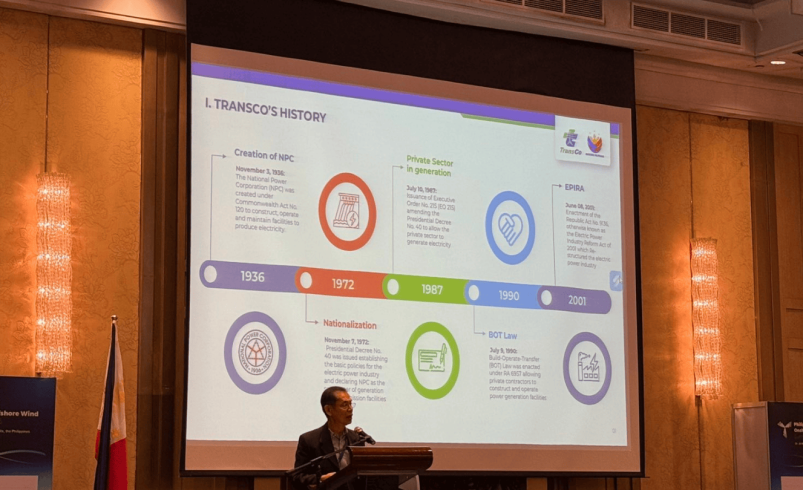
Transmission development timelines, which can stretch up to a decade, are emerging as a critical constraint on the Philippines’ renewable energy buildout, where wind and solar projects can be completed in as little as one year, according to National Transmission Corporation (TRANSCO).
The mismatch is creating a structural bottleneck that could delay project integration, trigger grid congestion, and expose system stability risks just as the country accelerates large-scale renewable deployment, especially offshore wind.
Speaking at the 4th Philippines Onshore Offshore Wind Summit, TRANSCO President Fortunato “Atoy” Leynes said the pace of renewable energy development is increasingly outstripping the grid’s ability to accommodate new capacity.

Leynes noted that while renewable energy facilities can be developed within a year, transmission planning and construction can take 10 years or more, resulting in a growing disconnect between generation and grid readiness.
“Transmission planning approaches are often misaligned with RE scale-up,” Leynes said, warning that the gap could limit efficient power delivery and delay the integration of new projects.
He added that renewable energy projects are often located in areas without sufficient transmission capacity. This leads to congestion and inefficiencies in the system.
Beyond infrastructure timelines, Leynes also pointed to a financing deadlock that could further slow development.
Renewable energy projects require access to transmission to secure financing, while transmission projects depend on demonstrated demand and cost recovery certainty before they can proceed.
This creates what he described as a “singular dilemma,” where neither side can move forward without the other.
“You cannot finance renewable energy projects without transmission, and you cannot build transmission without confirmed generation,” Leynes said.
In addition to these structural issues, Leynes cited technical challenges related to grid stability, particularly the intermittent nature of renewable energy sources.
He said variability in wind and solar generation can lead to frequency fluctuations, while inverter-based systems provide limited voltage support compared to conventional power plants.
“When there is not enough reserve capacity in the system, it is very difficult to manage the fluctuation of the system frequency,” he explained.
Leynes also pointed to reduced system inertia as a growing concern, which can make the grid more vulnerable to disturbances when large generators or loads suddenly go offline.
To address these challenges, the government is advancing a Smart and Green Grid Plan aimed at modernizing transmission infrastructure and supporting large-scale renewable integration.
The plan includes prioritizing grid reinforcement, streamlining permitting processes, and deploying advanced technologies such as smart grid systems.
Leynes said aligning transmission planning with renewable energy deployment will be critical to ensuring that new capacity can be delivered efficiently to demand centers.
As the Philippines ramps up its renewable energy ambitions, the widening gap between rapid project development and slower grid expansion could become a defining constraint on how quickly these projects can move from construction to actual power delivery.
How can the Philippines resolve the mismatch between fast-growing renewable capacity and slower transmission development to avoid delays in its energy transition?
Follow Power Philippines on Facebook and LinkedIn or join our Viber community for more updates.