Asia’s nuclear push gathers pace amid rising power demand
- June 24, 2026
- 0
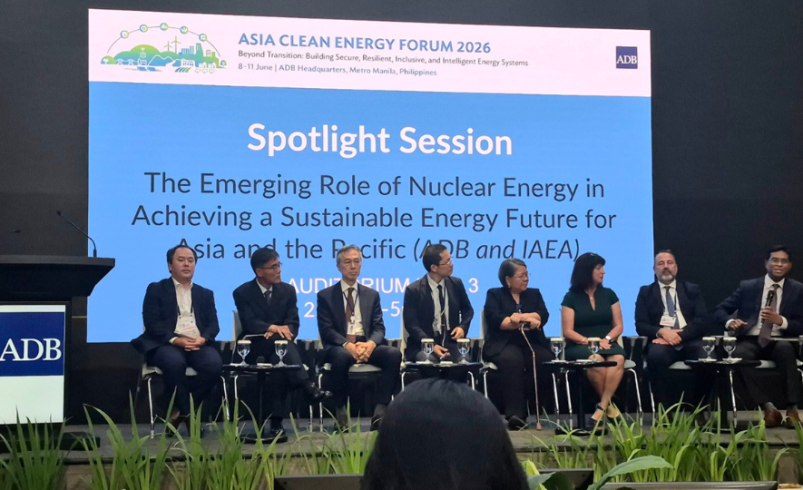
Nuclear energy is increasingly being viewed not as a quick fix but as a long-term strategic investment that could help Asian countries strengthen energy security, support economic growth, and sustain the clean energy transition, according to experts gathered at the Asian Clean Energy Forum (ACEF) 2026 hosted by the Asian Development Bank (ADB).
During a high-level panel discussion on nuclear readiness and deployment, policymakers, technology providers, financiers, and international agencies delivered a consistent message: countries exploring nuclear power must prepare for a lengthy and complex journey requiring sustained government commitment, financing, and institutional capacity.
“A nuclear power project is extremely complex, it can often be political, it will take a long time and it will probably be expensive,” said Elizabeth Urbanas, Deputy Assistant Secretary for Asia and the Americas at the U.S. Department of Energy.

“And that means a lot of issues are going to come up politically, financially, and it’s going to be important to be patient and play the long game,” she added. “It is a long-term investment, and it’s worth the wait.”
The discussion comes as several countries across Asia and the Pacific reassess their energy strategies amid rising electricity demand, decarbonization targets, and concerns over fuel supply security.
For the Philippines, nuclear energy is increasingly being positioned as a complement to the country’s rapidly expanding renewable energy portfolio.
Earlier this month, DOE announced that it is drafting a policy framework that could support the country’s first nuclear power project, including potential cost recovery mechanisms, community benefits, and investor incentives. The government is targeting the commissioning of its first nuclear power plant by 2032.
Department of Energy Undersecretary Rowena Cristina Guevara said the government sees nuclear power playing a role in balancing a grid that is expected to absorb large volumes of intermittent renewable energy over the coming years.
“In the last 40 years, the Philippines mothballed the Bataan Nuclear Power Plant. Not a single kilowatt-hour was used,” Guevara told the panel. “But in the next 40 years, we believe that nuclear energy is part of the energy transition.”
The DOE aims to raise the share of renewable energy in the power mix to 35% by 2030 and 50% by 2040, from around 25% today.
According to Guevara, the country has already secured commitments for about 20 gigawatts of renewable energy projects through its Green Energy Auction Program over the past two years, with another 10 GW set to be offered this year.
“With all of those coming in, nuclear energy is going to be necessarily part of our power system,” she said.
The panel also underscored that countries considering nuclear power should avoid treating it solely as an energy project.
Laurent Fabre, Head of Business Development at Électricité de France, described nuclear development as “a marathon, not a sprint,” stressing that success depends on long-term planning and strong government leadership.
“Embarking on a nuclear program is not a commercial project, it’s a sovereign undertaking that demands a whole-of-government approach,” Fabre said. “A nuclear program is not just another energy project to be outsourced. So this is actually a recipe for failure.”
Experts repeatedly highlighted the importance of building regulatory frameworks, skilled workforces, financing mechanisms, and public confidence before breaking ground on any nuclear facility.
Henri Paillere, Head of the Planning and Economic Studies Section at the International Atomic Energy Agency (IAEA), said countries now have access to a growing body of international expertise and support mechanisms.
“The better you prepare, the higher chance that your program will be successful, that it will run safely and efficiently,” Paillere said. “Yes, it will be expensive, but I would say it’s an investment into the future.”
Representatives from Japan and South Korea echoed the need for country-specific approaches, noting that there is no single model for financing or deploying nuclear power.
Satoru Yasuraoka, Director on International Affairs, Nuclear Energy Policy Division, at Japan’s Ministry of Economy, Trade and Industry (METI), compared nuclear development to “a long-term marriage,” saying countries must craft strategies that reflect their industrial capabilities, human resources, and grid maturity.
Meanwhile, Sang Won Lee, Head of SMR Development Laboratory at Korea Hydro & Nuclear Power (KHNP) emphasized nuclear power’s role in supporting higher levels of renewable energy while maintaining reliable electricity supply.
For ADB, which recently expanded its energy policy to include support for nuclear-related activities, the institution’s role will center on helping countries navigate the complexity of nuclear readiness.
Hideaki Iwasaki, Director General of ADB’s Energy and Transport Sectors 1, said the bank can help member countries evaluate nuclear power within the broader context of economic development, energy security, and sustainability.
“If you are not sure, you can come to us, and we can probably discuss with you how you used to go,” Iwasaki told participants. “We are not experts, but we are a partner with you.”
What are your thoughts on the Philippines’ nuclear ambitions? Can nuclear energy complement the country’s accelerating renewable energy buildout, or should policymakers prioritize other technologies? Join the discussion.
Follow Power Philippines on Facebook and LinkedIn or join our Viber community for more updates.