Fuel shock pushes ‘EV curiosity’ to survival as ACMobility targets 1,000 charge points
- May 18, 2026
- 0
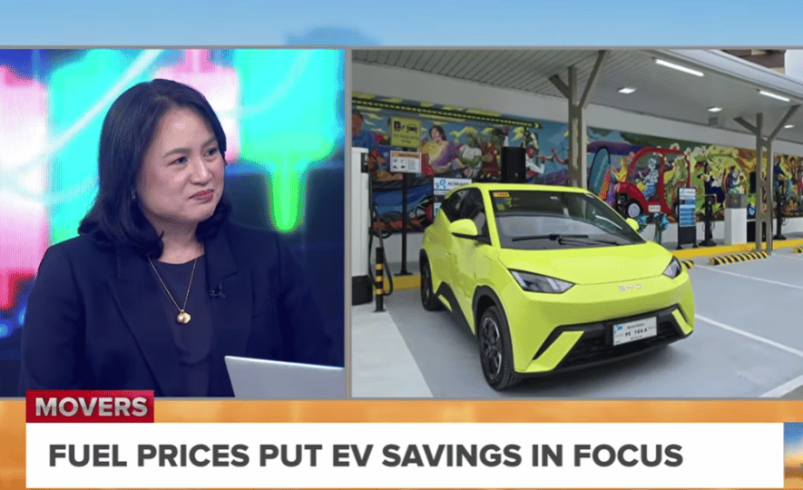
Photo credit: One News PH
The escalation of the Middle East conflict and its volatile impact on global energy markets have fundamentally transformed the Philippine transport landscape, forcing a rapid shift from mere interest in electric vehicles (EVs) to numbers-driven adoption as a tool for economic survival.
Speaking on the Money Talks livestream on May 13, Carla Buencamino, Head of Mobility Infrastructure at Ayala-owned ACMobility, revealed that soaring pump prices have completely altered public and institutional reception toward electric mobility.

Driven by this urgent demand, the company announced it is aggressively scaling up its network to surpass 1,000 charge points across the country within the year.
“We already have within those 200 locations that I mentioned over 500 charge points, and we’re pushing to go beyond 1,000 within the same year,” Buencamino told host Cathy Yang.
As the Middle East conflict passes its 74th day, volatile global energy shifts have pushed local gasoline prices to a punishing PHP 85 per liter, forcing consumers to fundamentally re-evaluate vehicle ownership, according to Buencamino.
Buencamino emphasized that the geopolitical shock has effectively compressed the country’s EV transition timeline. Reception has shifted from passive “curiosity” to aggressive, calculating adoption as public utility vehicle (PUV) operators and private motorists scramble to insulate themselves from runaway fuel inflation.
“In the beginning, it is about shifting their behavior into maybe lessening travels or taking public transportation or maybe even working from home, right? But now, I think there really is that openness already to taking on new technologies, especially for how they move around, and that could be technologies for hybrid or even battery electric vehicles,” Buencamino stated.
The financial incentive driving this shift is stark. Running a traditional internal combustion engine (ICE) vehicle currently drains approximately PHP 7 per kilometer. By contrast, charging an EV at home costs as little as PHP 2 per kilometer, while utilizing public fast DC chargers holds steady at roughly PHP 5 per kilometer.
“So, regardless of the kind of charging behavior you have, you would be saving anywhere between 30% to 70% of your fuel expense. And so, that’s really money that’s kept in the pocket, and that’s money spent for the home,” she explained.
However, this massive wave of public EV adoption is putting immense pressure on institutional stakeholders to eliminate structural bottlenecks. Currently, power grid constraints and arduous bureaucratic local government permitting mean developing a single charging site drags out over six months—a timeline the industry can no longer afford.
Buencamino, who also serves as Vice President of the Electric Vehicle Association of the Philippines (EVAP), is leveraging the current crisis to demand urgent regulatory relief from the state
“I think this is an opportunity also for the government to also assist the infrastructure players like us to hasten the process, right? And there are some challenges that we have—a lot of the locations require upgrades, like power upgrades, and there is a permitting process also that is a challenge for perhaps new industries,” Buencamino pointed out.
“So, hopefully, the Department of Energy is going to be able to release certain guidelines already that is going to hasten the process for the permitting, and that will allow us to speed up the infrastructure roll-out,” she added.
To ensure that the localized network can act as a comprehensive shield against future energy shocks, ACMobility clarified that its infrastructure reception remains strictly “brand-agnostic,” actively catering to passenger, commercial, and multi-brand fleet logistics.
“I’m very proud to say that we have been very deliberate in our strategy to keep ACMobility agnostic,” Buencamino said. “We have opened our network to all types of brands, no, and also to all types of users.”
While 75% of the current charging infrastructure remains concentrated within Metro Manila, the next leg of the 1,000-charge-point deployment will heavily prioritize high-traffic regional areas, expanding into gas stations and major highways across the Visayas and Mindanao.
Ultimately, Buencamino noted that navigating the global oil crisis requires a structural overhaul that relies on total ecosystem synergy.
“It takes a lot of stakeholders, but it really takes everyone to work together to make this happen, right? Because it’s not just about the vehicle. It’s about the charging infrastructure, it’s about policy support, it’s about the ecosystem around energy,” she said.
What is your take on this development? Do you think the localized power grid is resilient enough to handle a massive, rapid transition to electric vehicles? Can the Department of Energy move fast enough to clear the regulatory roadblocks for infrastructure developers?
Follow Power Philippines on Facebook and LinkedIn or join our Viber community for more news and updates on the Philippine energy sector.