ADB joins Global Offshore Wind Alliance as Philippines advances offshore wind plans
- June 10, 2026
- 0
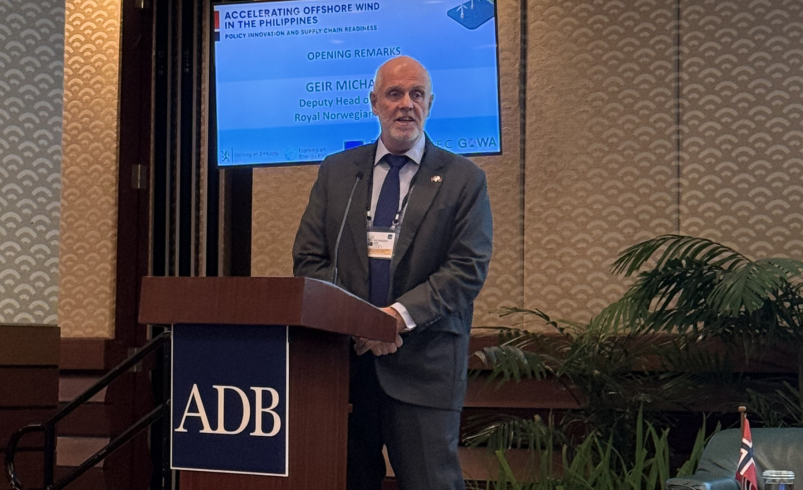
The Asian Development Bank (ADB) has joined the Global Offshore Wind Alliance (GOWA), a move the multilateral lender said will help strengthen regional cooperation and accelerate offshore wind development across Asia as the Philippines prepares for the next phase of its offshore wind ambitions.
The announcement was made during the opening session of “Accelerating Offshore Wind in the Philippines: Policy Innovation and Supply Chain Readiness,” held on June 8 as part of the Asia Clean Energy Forum (ACEF) 2026 in Manila.
ADB Director for Energy Transition Pradeep Tharakan said the institution hopes to bring a regional perspective to the alliance while deepening collaboration among governments, development partners, and industry stakeholders working to advance offshore wind deployment.

“Through this membership, we hope to bring a regional perspective, deepen collaboration with developing member countries, industrial development partners, and accelerate offshore wind development across the region,” Tharakan said.
The announcement comes as the Philippines continues laying the groundwork for a domestic offshore wind industry. According to Tharakan, ADB has supported the government throughout the offshore wind development process, including the design of the Green Energy Auction Program, environmental and social safeguard frameworks, amendments to the Philippine Grid Code, and port development planning.
The government is also moving forward with its first Green Energy Auction dedicated to bottom-fixed offshore wind projects, known as GEA-5, a development that industry stakeholders view as a major milestone for the sector.
However, speakers at the session emphasized that the industry’s next challenge is no longer policy development but implementation.
Janice Cheong, Head of Policy at the Global Wind Energy Council (GWEC) and Policy Advisor to GOWA, said the Philippines has already sent a strong signal to investors through its policy reforms and offshore wind initiatives.
“It’s therefore very significant and very exciting that the Philippines has moved forward to GEA-5, sends a clear signal that offshore wind is part of its country’s long-term energy strategy. But that ambition now needs to become execution, implementation, and scale,” Cheong said.
She added that the next 24 months will be critical for the Philippine offshore wind sector as projects move from planning to development.
While the Philippines is widely regarded as one of the world’s most promising offshore wind markets, speakers noted that success will depend on much more than the construction of turbines.
The session repeatedly highlighted the need for supporting infrastructure such as ports, logistics facilities, transmission networks, certification systems, workforce development programs, and local supply chains capable of supporting large-scale offshore wind deployment.
Royal Norwegian Embassy Deputy Head of Mission Geir Michalsen said discussions should focus on the entire ecosystem needed to support the industry.
“What is especially encouraging is that today’s discussions go beyond the turbines themselves. We will explore the entire ecosystem required for success, grid readiness, ports, logistics, standards and certification, supply chain development, safety, financing, and local industry participation,” Michalsen said.
Tharakan pointed to Denmark’s Port of Esbjerg as an example of how offshore wind can transform local economies. Once a fishing hub, the port has evolved into one of Europe’s leading offshore wind logistics and installation centers, supporting a broad ecosystem of manufacturers, service providers, and maritime operators.
The speakers also framed offshore wind as an energy security solution for countries that remain heavily dependent on imported fuels.
Cheong noted that recent global disruptions affecting fuel supply chains have reinforced the importance of developing domestic sources of energy. She said offshore wind can provide stable electricity generation for decades while reducing exposure to global fuel price volatility and geopolitical risks.
“For the Philippines, where import dependence currently remains high, offshore wind is energy security as a solution and in practice,” she said.
How can the Philippines accelerate the development of ports, grids, and supply chains needed to support a future offshore wind industry?
Follow Power Philippines on Facebook and LinkedIn or join our Viber community for more updates.