From Engineering Frustration to Global Reach: The Story Behind Virto Solar
- June 16, 2026
- 0
When Virto Solar was founded in Belgium in 2019, the company was not trying to reinvent solar technology. Instead, it was focused on a challenge familiar to many engineers: too much time spent on repetitive work, disconnected tools, and inefficient workflows.
What began as an attempt to solve practical engineering problems has since grown into a platform used to design more than 325 gigawatts (GW) of solar capacity across over 50 countries. Now, as the Philippines accelerates its renewable energy buildout, Virto Solar sees the country as one of the most promising solar markets in Asia.
An idea born from experience

Virto Solar’s story began with a problem familiar to many engineers.
CEO and founder Kim Eyckmans spent years working in photovoltaic (PV) engineering, where he repeatedly encountered the same challenges: manual processes, disconnected software tools, and repetitive design work that consumed valuable time throughout a project’s development cycle.
“After years of working as a PV engineer, Kim Eyckmans experienced firsthand how much time was lost through manual processes, disconnected tools, and repetitive design work,” the company said.
Rather than treating those inefficiencies as unavoidable, Eyckmans saw an opportunity to create a more streamlined approach to solar project development.
That vision became the foundation for Virto Solar.
The overlooked side of solar development
Much of the public discussion surrounding renewable energy focuses on installed capacity, financing, and construction milestones. Yet long before a solar project reaches those stages, developers and engineers must complete a series of technical and commercial tasks that ultimately determine whether a project moves forward.
Site evaluations, feasibility studies, energy yield calculations, layout optimization, permitting requirements, and engineering reviews all take place before construction begins.
“Solar engineering may not always be the most visible part of the industry, it plays a critical role in the success of every solar project,” Eyckmans said.
For the company, improving these processes is not simply about saving time. Better engineering workflows can influence project costs, development timelines, and overall project quality.
Growing beyond Belgium
What began as a solution to a common engineering challenge has since expanded far beyond Belgium.
Virto Solar says its platform is now used by developers, EPCs, and engineering teams across Europe, the Middle East, Africa, Latin America, and the Asia-Pacific region.
“We’re now active in more than 50 countries, with over 325 GW of solar capacity designed through Virto Solar,” Eyckmans said.
The company views this global adoption as evidence that many of the challenges facing solar professionals are remarkably similar regardless of geography. Whether projects are being developed in Europe, Africa, or Southeast Asia, developers often face pressure to shorten timelines, improve collaboration, and manage increasingly complex project pipelines.
Supporting projects from concept to construction
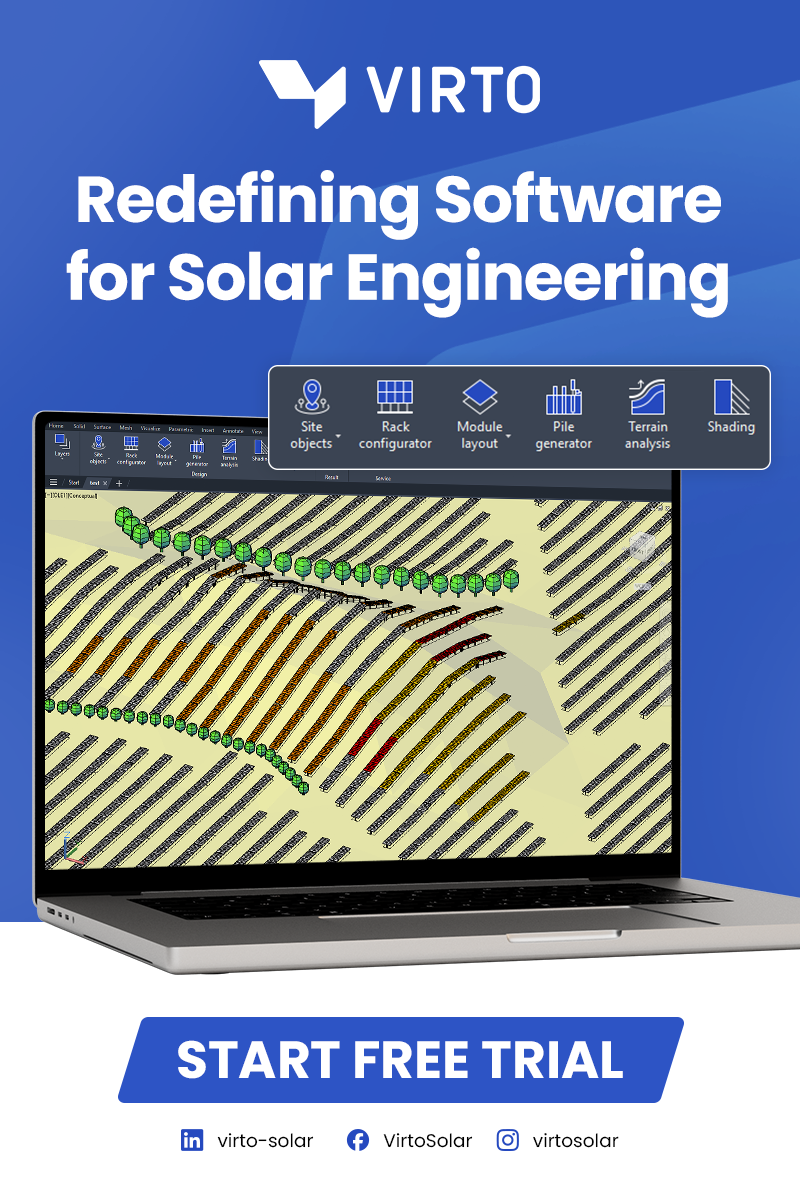
As Virto Solar expanded, it developed a suite of products designed to support different stages of a solar project’s lifecycle.
Virto.MAX focuses on early-stage project development, helping users create conceptual designs, feasibility studies, and proposals.
Virto.CAD supports detailed engineering work, including construction-ready layouts and technical documentation.
For larger organizations managing extensive project portfolios, Virto.CORE provides tools aimed at automating workflows and standardizing engineering processes.
Rather than viewing these products as standalone offerings, the company sees them as part of a broader effort to reduce friction throughout the development process.
“Each product solves a completely different problem depending on where your business is today and where you want to go next,” Eyckmans said.
Why the Philippines matters
Among the markets attracting the company’s attention, the Philippines stands out for both its renewable energy potential and its growth trajectory. The country continues to pursue ambitious renewable energy targets while experiencing rising electricity demand and increasing investment activity.
“The Philippines is no longer just an emerging solar market — it is becoming a strategic energy transition market in Asia,” Eyckmans said.
According to the company, the combination of strong solar resources, supportive policy signals, and growing demand creates an environment where renewable energy development can accelerate rapidly.
Virto Solar also believes the Philippine market remains agile compared to more mature renewable energy markets, allowing developers to adapt quickly to new technologies and business models.
Looking beyond today’s solar buildout
While solar deployment remains a priority, Virto Solar expects the industry to evolve beyond simply installing more photovoltaic capacity.
The company sees battery energy storage systems, hybrid renewable energy projects, and grid optimization solutions playing a larger role in the years ahead.
“The Philippine market could evolve very quickly from solar buildout to solar-plus-storage optimization,” Eyckmans said.
As projects become more sophisticated, developers will increasingly need tools and processes capable of managing greater complexity across the project lifecycle.
A long-term view of growth
Five years after its founding, Virto Solar says its ambitions in the Philippines extend beyond introducing software to a new market.
The company hopes to build long-term relationships with developers, EPCs, and engineering firms participating in the country’s renewable energy transition.
“We hope Virto Solar becomes known as a trusted partner that helps companies scale faster, work smarter, and deliver better solar projects,” Eyckmans said.
For Virto Solar, the Philippines represents more than another market expansion opportunity. It is a chance to participate in one of Southeast Asia’s fastest-growing renewable energy sectors while helping developers navigate the increasingly complex path from project concept to completion.
As the Philippine solar industry continues to grow, how important will efficient engineering and project development processes become in shaping the next phase of renewable energy expansion?
Follow Power Philippines on Facebook and LinkedIn or join our Viber community for more updates.