EvoEnergi powers 224 McDonald’s Luzon stores under RAP
- April 29, 2026
- 0
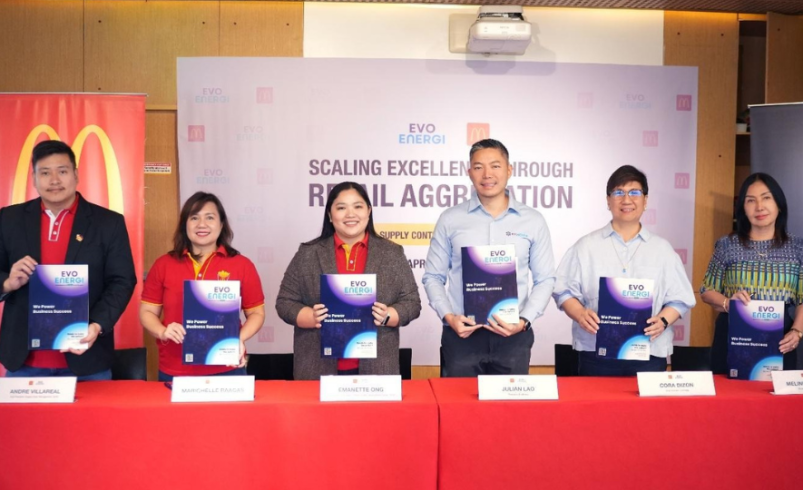
In photo (L-R): GADC’s Vice President for Supply Chain Management Andre Villareal, Vice President for Store Network Expansion Marichelle M. Raagas, and Vice President and Head of the Business Development Group, Emanette C. Ong; EvoEnergi’s President Julian Lao, Chief Adviser Cora Dizon and Strategic Adviser Melinda Ocampo
More than 220 McDonald’s stores in Luzon will shift to aggregated power supply after Golden Arches Development Corporation (GADC) tapped EvoEnergi as its retail electricity supplier, marking one of the largest deployments so far under the government’s Retail Aggregation Program (RAP).
The partnership was formally announced during a ceremonial signing event in Taguig City, where both companies confirmed the supply of conventional and renewable energy to 224 McDonald’s outlets grouped into 23 retail aggregation clusters.

The sites carry a combined demand of about 22 megawatts (MW) and are located within the franchise areas of Manila Electric Company (Meralco), Pangasinan III Electric Cooperative, Inc. (PANELCO III), and Batangas II Electric Cooperative, Inc. (BATELEC II).
The deal follows a competitive bidding process and represents GADC’s first use of RAP, a scheme overseen by the Energy Regulatory Commission (ERC) that allows multiple facilities under the same distribution utility to pool demand and procure power more competitively.
“We are committed to being more than just an electricity supplier — we aim to be a trusted, long term partner, providing stability, transparency, and support that enhance the everyday McDonald’s experience for Filipinos, while upholding the brand’s legacy and standards,”
EvoEnergi President Julian Lao said.
For GADC, the shift is expected to improve cost visibility and operational planning across its expanding store network.
“With RAP and EvoEnergi’s service, we have the ability to better plan, budget, and potentially realize savings on energy. This for us is a significant step forward and contributes to our ability to sustainability and provide affordable and value meals to our Filipino customers,” said Emanette C. Ong, McDonald’s Philippines vice president and head of business development.
The Department of Energy (DOE) welcomed the move, with Undersecretary Mylene C. Capongcol urging more companies to explore customer choice mechanisms such as RAP amid global energy uncertainties.
At the same event, ERC Director Sharon Montañer underscored the broader market implications of aggregation.
“McDonald’s and EvoEnergi are demonstrating exactly how retail aggregation fosters consumer empowerment and strengthens market resilience. They are proving that smart, sustainable energy choices do not just benefit the corporate bottom line—they can uplift entire communities,” she said.
EvoEnergi said it has aggregated 29 retail groups with a combined demand of 21 MW as of February 2026, based on ERC data.
Is RAP starting to scale meaningfully in the Philippines? Share your insights on whether aggregation can deliver sustained savings and reliability for large commercial loads—and what gaps still need to be addressed.
Follow Power Philippines on Facebook and LinkedIn or join our Viber community for more news and updates on the Philippine energy sector.