Pulse Asia survey shows 93% of Filipinos see need for affordable rooftop solar
- July 2, 2026
- 0
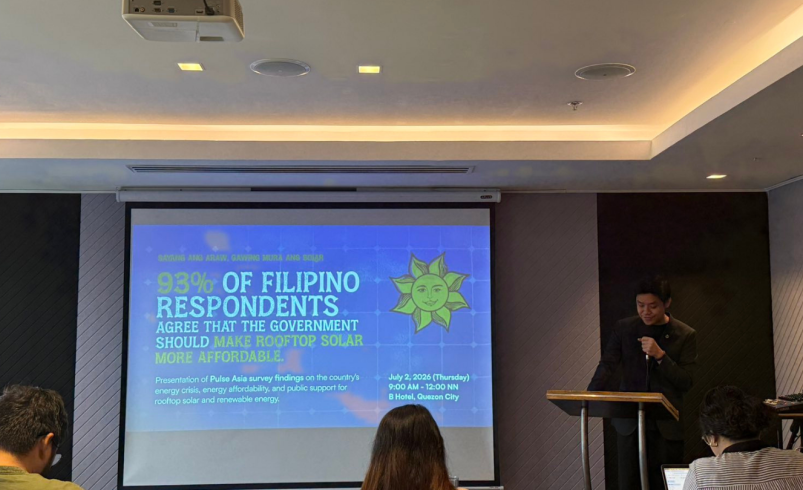
A new Pulse Asia survey cited by the “Sayang Ang Araw, Gawing Mura ang Solar” campaign found that 93% of Filipinos believe rising electricity demand makes affordable rooftop solar increasingly necessary.
The campaign said the findings show strong public support for government action to lower the cost of rooftop solar, improve access to information, expand financing options, and remove policy and regulatory barriers that make adoption difficult for households.
The survey also found that 93% of respondents believe a mainstream transition to rooftop solar is achievable if citizens have access to the right information, while 91% said widespread adoption is viable if affordable financing options are available.

The campaign said the issue is no longer convincing Filipinos about the benefits of rooftop solar, but making the technology easier and more affordable to adopt.
Amidst rising electricity costs, 85% of respondents now view rooftop solar as a necessity rather than a luxury.
The survey also showed broader concern over the country’s energy situation, with 97% of respondents saying they are concerned about current energy challenges. It also found that 77% recognized the Philippines’ continued dependence on imported oil, coal, and natural gas.
When asked about long-term solutions, 66% identified expanding renewable energy as the most effective approach, with rooftop solar affordability emerging as the public’s highest priority among renewable energy measures.
“These findings send a clear policy signal: Filipinos are not rejecting solar energy; they are asking for the conditions that would allow them to access it,” said Alberto Dalusung III, Energy Transition Advisor for the Institute for Climate and Sustainable Cities.
“Rooftop solar can help consumers manage electricity costs, participate more actively in the energy system, and strengthen national energy security by reducing dependence on imported fuels,” he added.
Brenda Valerio, Philippines Country Director of New Energy Nexus, said financing remains one of the largest hurdles to rooftop solar adoption.
“The demand is already there; what many Filipino families need now is structural access,” Valerio said.
“By expanding affordable financing options—from specialized solar loans and installment plans to leasing models and partnerships with financial institutions—we can make clean energy inclusive. The transition shouldn’t be limited to those who can afford the upfront costs; it must be within reach of every Filipino family,” she added.
The campaign is pushing for immediate fiscal and regulatory reforms to make rooftop solar more accessible. These include removing the value-added tax on solar technologies, improving net-metering implementation, ensuring fair compensation for excess power fed back to the grid, and streamlining and digitizing permitting processes.
Net metering allows electricity users with rooftop solar systems to export excess power to the grid and receive credits or compensation, helping lower their electricity costs.
Philippine Solar and Storage Energy Alliance President Jose Rafael Mendoza said the local solar sector is ready to deliver if the government reduces existing market friction.
“The consumer interest and technology readiness are already present, yet taxes, fees, heavy administrative processes, financing gaps, and coordination challenges still make rooftop solar harder and more expensive to adopt,” Mendoza said.
The campaign said the survey reflects an urgent public mandate for administrative and legislative policymakers to advance reforms that can make rooftop solar affordable for more households.
Can government reforms turn strong public support for rooftop solar into actual household adoption?
Follow Power Philippines on Facebook and LinkedIn or join our Viber community for more updates.